


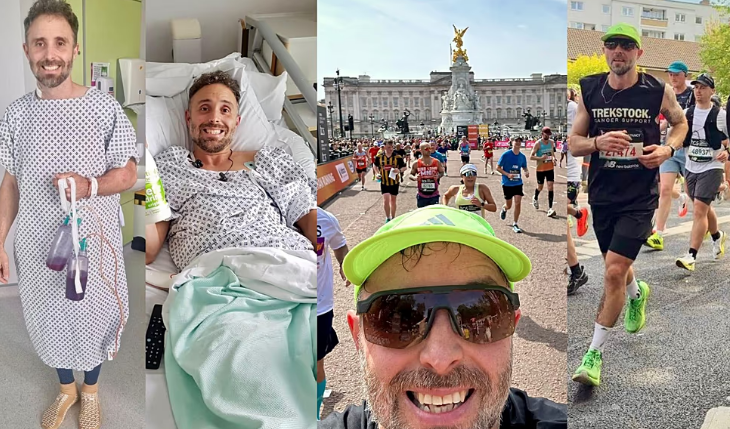
When more than a million people entered the ballot for the 2026 London Marathon, Andy Spray was not among them. At the time, the former semi-professional skateboarder from Tunbridge Wells was facing a diagnosis that would reshape his life far beyond any race entry.
In 2024, what doctors initially believed to be an abscess linked to Crohn’s disease turned out to be something far more serious. After being advised to undergo an MRI, Andy was diagnosed with stage three colon cancer, a rare form located in the pelvic region.
The news marked the beginning of an intense medical journey. His treatment included chemotherapy every two weeks, a stoma procedure, five weeks of radiotherapy and major surgery that removed parts of his colon, rectum and surrounding tissue. Reconstructive surgery followed.
Despite the physical toll, Andy never fully stopped moving. Even during chemotherapy, he would return to running in the brief windows when side effects eased.
“I had chemotherapy every two weeks. I’d feel absolutely terrible for a few days, but then I’d go running again,” he said in an interview with Euronews Health.
He began sharing his experience online, speaking openly about the difficult days while maintaining a largely positive outlook. The response from friends, family and strangers online, he said, helped him stay grounded.
About 11 months ago, after undergoing major surgery, Andy could barely walk or touch his feet. Recovery was slow, but within months he was back in running shoes, gradually building up to half-marathons and eventually the London Marathon.
A turning point came when he connected with Trekstock, a charity supporting young people affected by cancer through physical activity. Through the organisation, Andy began exercising with others in similar situations, often via virtual sessions before progressing to in-person training.
That support helped him secure a place in the London Marathon and launch a fundraising campaign that has raised more than £4,000 for cancer support initiatives.
Andy, who works as a carpenter, said his experience has changed how he views illness and recovery. He believes public understanding of cancer has not kept pace with medical advances.
“There is still a stigma because people think of cancer as a death sentence,” he said. “But treatment has improved so much. Outcomes are very different now.”
He also urged people to pay attention to symptoms such as blood in the stool, persistent pain or changes in bowel habits, noting that early diagnosis can significantly improve outcomes.
Reflecting on his journey, Andy credits mental resilience, support from those around him and his history of recovering from skateboarding injuries for helping him through treatment.
While recovery from major surgery can take up to 18 months, he now feels close to full strength. Crossing the finish line in London, he said, marked a moment that went beyond sport.
“I feel like I’m pretty much there,” he said.
