


The United States has carried out a seventh consecutive night of strikes on Iran since President Donald Trump declared a temporary ceasefire agreement over, while Tehran has responded with attacks on American allies and regional targets.
US Central Command, known as Centcom, said its forces targeted surveillance sites, military logistics infrastructure, underground weapons storage facilities and maritime capabilities.
The operation ended at 21:30 Eastern Time after several hours of attacks, according to Centcom. The military said fighter aircraft, drones, warships and other assets were used.
Iranian state media reported explosions in the central city of Yazd, on Qeshm Island and near the port of Bandar Abbas, close to the Strait of Hormuz.
Iran said it had responded by targeting US allies across the region. Kuwait reported that another electricity generation and water desalination facility had been hit, causing a fire and forcing some power units to be shut down.
“Another electricity and water distillation plant was targeted by a hostile attack that led to a fire erupting in one of the plant’s components,” Kuwait’s Ministry of Electricity and Water said.
Jordan’s military said it intercepted 10 Iranian missiles that entered its airspace overnight, with no damage reported. Bahrain also said its air defence systems had thwarted Iranian attacks.
The latest escalation follows the collapse of a US-Iran ceasefire reached in June to allow negotiations aimed at ending the conflict. The truce was largely observed, although tensions continued after Iranian forces attacked oil tankers and demanded that vessels seek permission to cross the Strait of Hormuz.
The United States subsequently carried out strikes against Iran and later reintroduced a naval blockade targeting Iranian ports. Tehran has declared the Strait of Hormuz closed to shipping, and commercial traffic through the vital waterway has largely halted.
Around one-fifth of the world’s oil and liquefied natural gas normally passes through the strait, raising concerns about the impact of the conflict on global energy supplies. International Energy Agency chief Fatih Birol has warned of potential risks to energy markets.
Centcom also rejected a report by Iran’s Fars news agency claiming that two oil tankers had exploded while travelling through a mined route south of the Strait of Hormuz, calling the report false.
Iranian forces have also claimed attacks on US military facilities in Kuwait, Bahrain, Jordan and Syria. Washington has denied some of those claims.
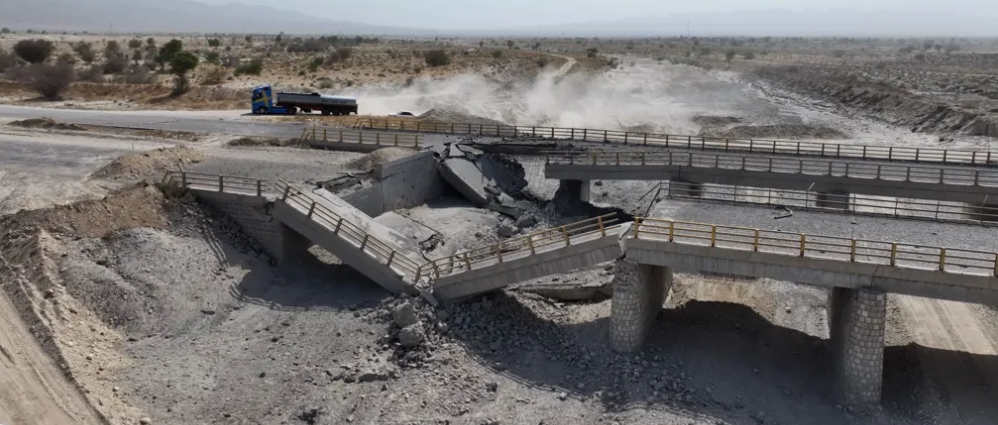
The United States has also rejected Iranian accusations that its forces deliberately targeted civilian infrastructure. However, BBC verification found damage to Gariveh Bridge in Hormozgan province, where local authorities said seven people were killed.
The White House said US forces had targeted military sites, while Centcom said a control tower at Chabahar port was destroyed because it formed part of an Islamic Revolutionary Guard Corps maritime surveillance network.
The continuing exchanges have raised fears of a wider regional conflict and increased pressure on the global energy supply chain.
