


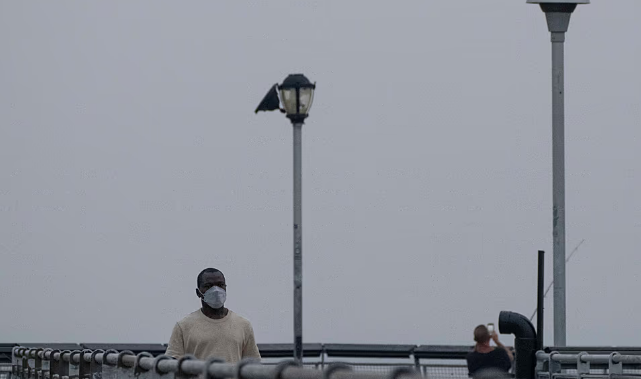
Wildfires burning across parts of Europe this summer are not only threatening communities close to the flames but are also affecting air quality hundreds of kilometres away as smoke spreads across borders.
Since the start of the year, 1,083 fires have been detected across Europe, releasing more than 7.01 million tonnes of carbon dioxide, according to available data. France, Germany, Greece, Spain and Portugal have all experienced wildfires this summer, while much of western and central Europe is facing extreme fire danger conditions.
Smoke from fires can travel long distances, exposing people far from the original source to harmful pollution. Even residents who cannot see or smell smoke may be breathing unhealthy air.
Wildfire smoke contains a mixture of hazardous pollutants, including fine particulate matter known as PM2.5, nitrogen dioxide, ozone, aromatic hydrocarbons and lead. Fires involving homes and other buildings can release additional toxic substances from plastics, electronics, furniture and paints.
Health experts warn that inhaling these particles can trigger inflammation and oxidative stress. The pollutants can also enter the bloodstream and affect organs throughout the body.
People can monitor local conditions through air quality information provided by the European Environment Agency. The Copernicus Earth Observation Programme also publishes daily updates and four-day forecasts covering pollutants, pollen and aerosol particles. Many smartphones now display local air quality information through weather applications.
Indoor air quality monitors can also help residents determine whether pollution has entered their homes. Joseph Allen, director of Harvard University’s Healthy Buildings Program, said affordable monitoring devices are now widely available.
When wildfire smoke reaches unhealthy levels, health experts recommend staying indoors as much as possible and keeping doors and windows closed. People who must go outside can reduce exposure by wearing a properly fitted N95, KN95 or KF94 respirator mask.
N95 masks are designed to filter most fine particles when fitted correctly, offering greater protection than ordinary cloth or surgical masks.
Residents can also take steps to improve indoor air quality. Closing windows, using air conditioning on the recirculation setting and blocking gaps around doors can help prevent smoke from entering.
Replacing standard air-conditioning filters with MERV 13 filters can provide additional protection, provided they are correctly installed and compatible with the system.
Portable air purifiers can also reduce indoor pollution. Experts recommend keeping one running in the room where people spend most of their time, particularly during periods of heavy smoke.
As wildfire activity increases in several parts of Europe, authorities and health experts are urging residents to monitor air quality, limit outdoor exposure during pollution spikes and take practical measures to keep indoor air cleaner. The advice is especially important for people who are more vulnerable to the effects of polluted air.
