


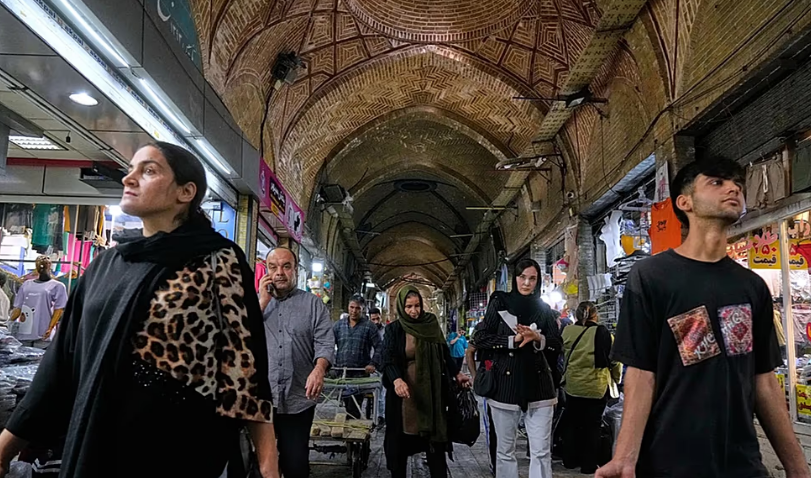
Tehran, Iran – Iranian traders and shopkeepers staged a second day of protests on Monday after the country’s currency plunged to a record low against the US dollar, highlighting growing public frustration over economic instability.
Videos circulating on social media showed hundreds of demonstrators gathering in Saadi Street in central Tehran and the Shush neighborhood near the city’s Grand Bazaar, a historic commercial hub that played a key role in the 1979 Islamic Revolution. Many traders closed their shops and called on others to follow suit. The semi-official ILNA news agency reported that while some businesses remained open, most halted trading in solidarity.
Witnesses said security was tight around the demonstrations, but there were no reports of police raids. On Sunday, protest activity had been confined to two major mobile markets in downtown Tehran, where participants chanted slogans critical of the government.
The protests came as the rial continued its sharp decline. On Sunday, it fell to 1.42 million per US dollar on the free market, before slightly improving to 1.38 million on Monday. Exchange rates differ widely between official and street-level markets. On official platforms, the euro trades at around 49,000 rials, reflecting the state-controlled system largely inaccessible to ordinary Iranians. By contrast, the free-market rate exceeds one million rials, or roughly 150,000 tomans, revealing a widening gap fueled by inflation, international sanctions, and capital flight.
The currency’s rapid depreciation is driving up prices for everyday goods and essentials, placing additional strain on households. Recent data from the Iranian Statistics Center showed annual inflation in December reached 42.2 percent, up 1.8 percentage points from November. Food prices soared 72 percent, while healthcare and medical costs rose 50 percent compared with the same period last year. Analysts warn that these trends could signal the onset of hyperinflation, particularly as gasoline prices were recently increased.
Concerns have been compounded by reports that the government plans to raise taxes ahead of the Iranian new year on 21 March. Many Iranians recall that the rial officially traded at 32,000 to the dollar at the time of the 2015 nuclear deal, which briefly eased sanctions in exchange for stricter nuclear oversight.
Tensions with the United States and regional uncertainties have also weighed heavily on markets. After the US withdrew from the 2015 accord in 2018, sanctions were reimposed, including through a UN “snapback” mechanism in September, freezing Iranian assets abroad and restricting arms transactions. Additional fears of a broader regional conflict, following a June flare-up with Israel, have added to the economic unease.
As the rial continues to weaken, traders and ordinary citizens are bracing for further economic hardship, with public protests highlighting the growing discontent over Iran’s financial and political challenges.
