


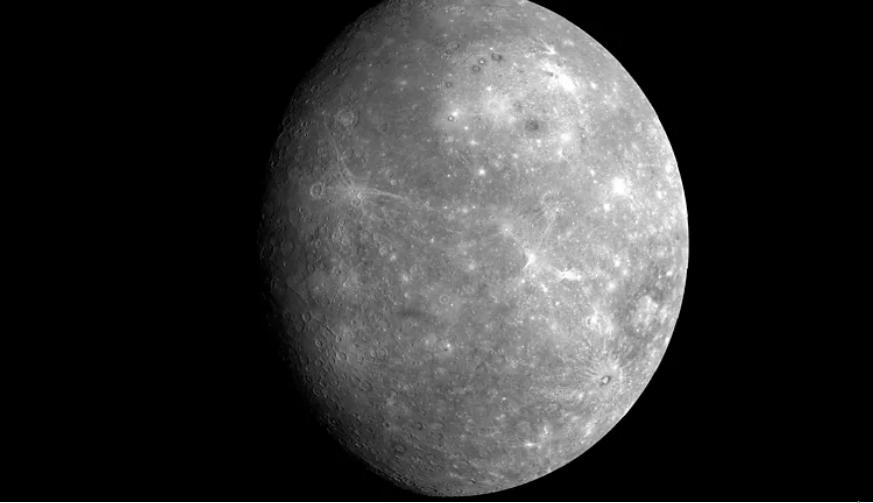
Mercury, the smallest planet in the Solar System and closest to the Sun, continues to puzzle astronomers with its unusual composition and orbit. Scientists hope that the arrival of the BepiColombo mission in 2026 may finally shed light on the planet’s origins.
At first glance, Mercury appears unremarkable. Its surface is barren, its atmosphere extremely thin, and conditions make it impossible for life to exist. Yet its internal structure and position make it one of the Solar System’s most enigmatic worlds. Despite being just 20 times less massive than Earth, Mercury is the second densest planet after Earth, due to a disproportionately large metallic core that makes up about 85% of its radius.
The planet’s close orbit around the Sun and its unusual density challenge traditional models of planet formation. “There’s some key subtlety that we’re missing,” says Sean Raymond, an expert in planetary formation at the University of Bordeaux. Mercury’s existence and structure remain among the most significant unanswered questions in planetary science.
BepiColombo, a joint European and Japanese mission launched in 2018, is expected to enter orbit around Mercury in November 2026. One of its primary objectives is to investigate the planet’s origin and evolution. Understanding Mercury’s formation may also offer insights into the composition of exoplanets, as the planet’s unusual characteristics provide a rare point of comparison.
Past missions have only deepened the mystery. NASA’s Mariner 10 flybys in the 1970s revealed Mercury’s dense core, while the Messenger orbiter (2011–2015) discovered volatile elements such as potassium and thorium on its surface, which should have been evaporated by the Sun’s intense radiation. Messenger also found water ice trapped in shadowed polar craters, adding further questions about the planet’s formation and survival near the Sun.
Several hypotheses attempt to explain Mercury’s unusual structure. One leading idea is that the planet once had a larger mantle and crust, which were stripped away by a massive collision early in its history. However, such an impact would likely have removed volatile elements, leaving scientists puzzled by Messenger’s findings. Alternative theories suggest Mercury may have formed from iron-rich material closer to the Sun, with lighter elements evaporated by solar activity, or that it was involved in complex collisions as a smaller “impactor” rather than a target.
Despite decades of research, no single explanation fully accounts for Mercury’s small size, high density, and retained volatiles. “The formation of Mercury is a major problem,” says Nicola Tosi, a planetary scientist at the German Aerospace Centre. “It’s still unclear why Mercury looks like it does.”
With BepiColombo poised to begin its detailed observations, scientists are hopeful that new data will finally unravel the planet’s mysteries, providing a clearer understanding of Mercury and offering clues about planet formation across the universe.
