


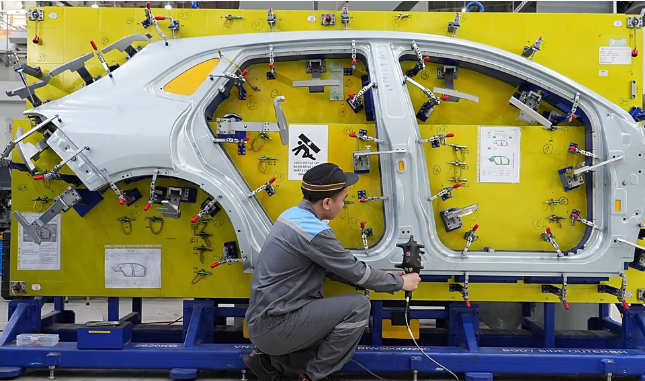
China’s manufacturing sector showed little sign of expansion in May, with official data indicating activity slipping to its weakest level in three months as global energy disruptions and soft domestic demand continue to test the resilience of the world’s second-largest economy.
According to figures released by the National Bureau of Statistics and the China Federation of Logistics and Purchasing, the official manufacturing purchasing managers’ index (PMI) fell to 50 in May, down from 50.3 in April. The reading sits exactly at the threshold that separates expansion from contraction, reflecting a sector that is no longer clearly growing.
Behind the headline figure, the underlying data pointed to further weakness. New orders dropped to 49.9, slipping back into contraction territory after briefly expanding the previous month. Production eased to 51.2, while raw material inventories fell to 48.6, suggesting firms are becoming more cautious about future output.
Not all segments moved in the same direction. High-tech manufacturing and equipment manufacturing offered some support, rising to 52.9 and 52.1 respectively. Officials said these areas continued to benefit from ongoing industrial upgrading and targeted policy support, even as broader demand softened.
The slowdown comes at a time when global energy markets remain under strain following the war in Iran and disruptions in the Strait of Hormuz, a key route for global oil shipments. The crisis has pushed energy prices higher and created volatility across supply chains, although China has so far been partially insulated.
Beijing’s large strategic reserves, estimated at around 1.4 billion barrels, along with increased reliance on coal and accelerated investment in renewable energy, have helped soften the immediate impact. Analysts at HSBC noted that China remains “relatively more shielded” compared with other Asian economies due to its diversified energy structure.
However, economists warn that prolonged disruption could still filter through to production costs and industrial activity over time.
The bigger concern for policymakers remains domestic demand. A prolonged downturn in the property sector has weakened household confidence and spending. Retail sales growth slowed sharply in April, prompting HSBC to cut its 2026 forecast for China’s retail expansion to 2.8%, down from a previous estimate of 5.2%.
While exports have remained relatively resilient—particularly to Europe and Southeast Asia—shipments to the United States have declined over the past year. Analysts say external demand is now doing most of the heavy lifting for Chinese growth.
Beijing has set a 2026 growth target of between 4.5% and 5%, its lowest in decades. Economists at Morgan Stanley say the target remains achievable but caution that global oil volatility and weak consumption will be key risks.
Recent diplomatic engagement between the United States and China has offered some optimism for trade stability, but analysts say any recovery in manufacturing will depend on whether domestic demand can regain momentum in the months ahead.
