


What once belonged to the realm of science fiction is slowly becoming science fact, as researchers push the boundaries of what computing means — by building “living” computers made from human cells.
At the forefront of this experimental field, known as biocomputing, is a team of Swiss scientists at FinalSpark, a laboratory aiming to create computers powered by living neurons. Their goal: to develop “wetware” systems — machines that think and learn like artificial intelligence (AI) models, but use only a fraction of the energy of traditional data centres.
Dr. Fred Jordan, co-founder of FinalSpark, envisions a future where data centres could one day house living servers capable of processing information biologically. “When you start to say, ‘I’m going to use a neuron like a little machine,’ it changes the way we think about our own brains,” he said.
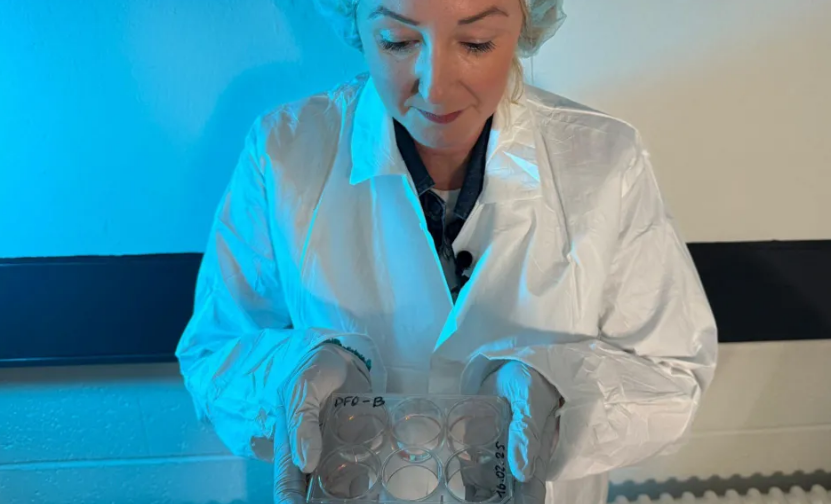
The lab’s biocomputers begin life as stem cells derived from human skin, sourced from certified suppliers in Japan. These cells are cultured into organoids — tiny, brain-like clusters of neurons and supporting cells. Although they are far simpler than a human brain, organoids share its basic building blocks.
After several months of development, these mini-brains are connected to electrodes that allow them to send and receive electrical signals. Researchers can press a key to stimulate the neurons and monitor their responses on a screen, observing faint bursts of electrical activity. These simple experiments are the first steps toward training the organoids to “learn” — much like AI systems that recognize images or patterns.
But building a living computer comes with unique challenges. “Organoids don’t have blood vessels,” explained Professor Simon Schultz, Director of the Centre for Neurotechnology at Imperial College London. “Without a proper nutrient supply, they can’t survive long term — that’s the biggest challenge.”
Currently, FinalSpark’s organoids live for about four months. Intriguingly, before dying, they sometimes produce a sudden burst of electrical activity — a mysterious phenomenon the team continues to study.
FinalSpark is not alone in the field. In Australia, Cortical Labs made headlines after teaching artificial neurons to play the computer game Pong, while researchers at Johns Hopkins University in the US are using “mini-brains” to study neurological diseases like Alzheimer’s.
Despite the excitement, experts caution that biocomputing remains in its infancy. “It should complement — not replace — silicon AI,” said Dr. Lena Smirnova of Johns Hopkins, noting its potential to improve disease research and reduce animal testing.
For Dr. Jordan, however, the work feels like stepping into the pages of a science fiction novel. “I always loved those stories,” he said. “Now, I feel like I’m living one.”
