


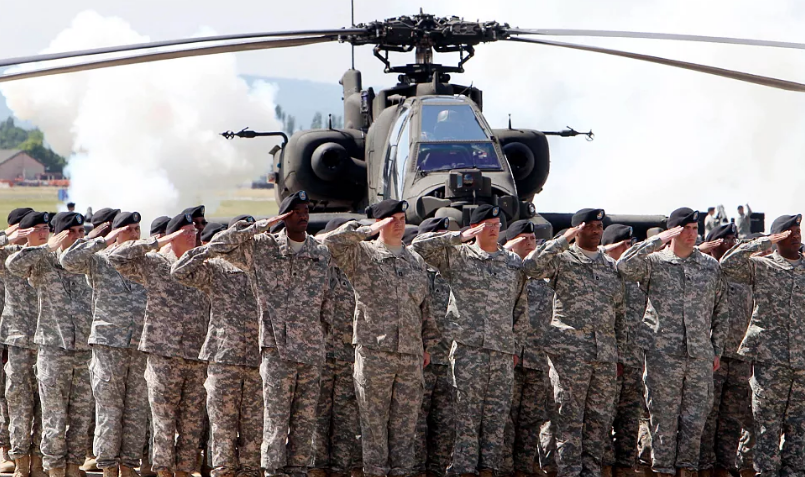
Former US President Donald Trump’s repeated threats to withdraw American forces from Europe have reignited fears among NATO allies and defence experts, though many believe such a move remains improbable due to significant political, logistical, and strategic barriers.
As Trump’s “America First” rhetoric resurfaces in the run-up to the U.S. election, European leaders have grown increasingly uneasy. Unlike the 2012 troop reduction announced under then-Defense Secretary Leon Panetta—met with relative calm—Trump’s suggestion of a full-scale withdrawal has sent shockwaves through European capitals. The key difference: Panetta reaffirmed America’s unwavering commitment to NATO, while Trump has questioned the alliance’s value and accused European nations of underfunding their own defence.
Tensions escalated earlier this year when leaked messages revealed disparaging remarks from Trump’s vice president and defence secretary about European allies. “European freeloading” was a term reportedly used by Defence Secretary Pete Hegseth, according to The Atlantic.
While concerns have eased somewhat ahead of this week’s NATO summit in The Hague, officials remain on edge over whether Trump will announce a major military shift. The Pentagon has declined to comment, but U.S. Ambassador to NATO Matthew Whitaker sought to reassure allies. “America needs allies—we can’t do it all alone,” he said during a forum in Brussels, dismissing reports of a troop drawdown as false.
Currently, around 84,000 U.S. service members are stationed across Europe, with large contingents in Germany (40,000), Poland (14,000), Italy (13,000), and the UK (10,000). These troops include both combat units and support personnel essential to operating major facilities such as Ramstein Air Base and the Landstuhl Regional Medical Center in Germany.
Experts warn that withdrawing such a force would be a massive undertaking. “It would take at least a year,” said Mark Cancian of the Center for Strategic and International Studies (CSIS). “A quarter of a million people—including families—would be affected. U.S. bases couldn’t absorb them all.”
Politically, any withdrawal would likely require Congressional approval, which is far from guaranteed. “Trump tried this during his first term, but the plan was shelved due to resistance from the Pentagon and Congress,” said Ian Lesser of the German Marshall Fund.
Even Trump allies acknowledge the limits. “Trump’s goal isn’t to pull out,” said Daniel Runde of BGR Group. “He wants to pressure Europe into boosting defence spending to 5% of GDP. Then he’ll call it a win and move on.”
A recent study by the International Institute for Strategic Studies (IISS) estimated that replacing U.S. military capabilities in Europe would cost European nations approximately $1 trillion. With war still raging in Ukraine and regional tensions with Iran escalating, most analysts agree a U.S. withdrawal is unlikely—for now.
