


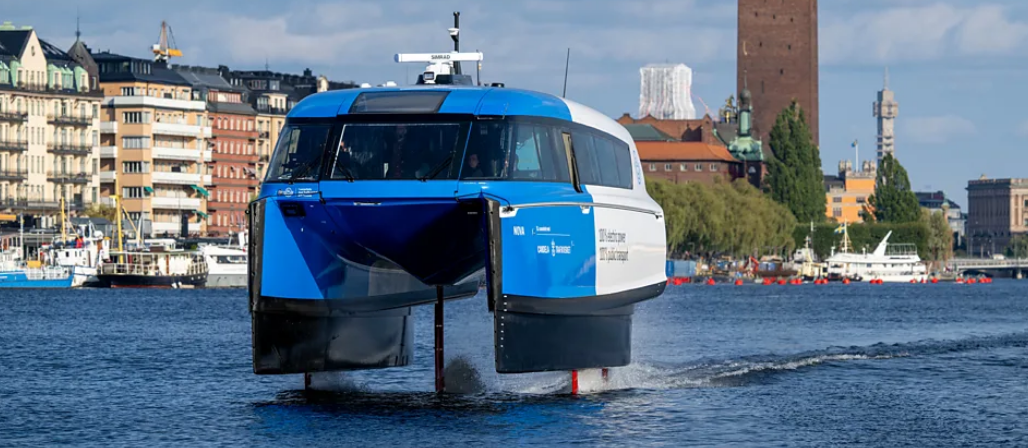
Once an invention aimed at speed, the hydrofoil is now being revived as a cleaner and more efficient solution for water transport, promising to cut fuel use, reduce emissions, and even eliminate seasickness for passengers.
The concept dates back more than 150 years. In 1869, Parisian inventor Emmanuel Denis Farcot filed a patent for a rowing boat that could rise above the water using wing-like foils. Although it is unclear whether his version ever sailed, others carried the idea forward. Italian engineer Enrico Forlanini launched a working hydrofoil on Lake Maggiore in 1906, and Canadian inventor Alexander Graham Bell built several hydrofoil boats in his pursuit of early flight technology. His model, the HD-4, set a world speed record of 70 mph (113 km/h) in 1919 — a title it held for a decade.
“The early hydrofoils gave boats remarkable speed and low drag,” explains Jakob Kuttenkeuler, professor of naval architecture at KTH Royal Institute of Technology in Sweden. “In the early 1900s, people wanted to go faster — now the driving force is electrification.”
In the mid-20th century, hydrofoil development stalled due to heavy materials and reliance on fossil fuels. But advances in batteries, lightweight composites, and computerized stabilization systems have sparked a modern revival. Kuttenkeuler himself helped pioneer the eFoil — a surfboard mounted on a hydrofoil — which has gained popularity among water sports enthusiasts and tech billionaires alike.
The real potential, however, lies in cleaner public transport. Swedish engineer Gustav Hasselskog, concerned about the fuel consumption of his personal boat, founded Candela in 2014 to develop electric hydrofoil vessels. By lifting the hull out of the water, drag is reduced dramatically — cutting energy use by up to 80%. Candela’s all-electric ferries now operate on trial routes in Stockholm, where they can halve travel times while producing zero emissions and minimal wake.
Globally, the technology is catching on. Candela has received orders for ferries in India, Saudi Arabia, the Maldives, and the United States. In Washington state, Kitsap Transit is developing a 150-passenger electric hydrofoil prototype, backed by over $6 million in public funding.
Despite challenges — such as limited range, battery charging time, and vulnerability to underwater obstacles — supporters believe hydrofoils could transform short-distance maritime transport. In Stockholm alone, Candela estimates its ferries could save the city up to 40% in operating costs.
As Kuttenkeuler puts it, “Hydrofoils aren’t just fast anymore — they’re a bridge to cleaner, smarter travel on water.”
