


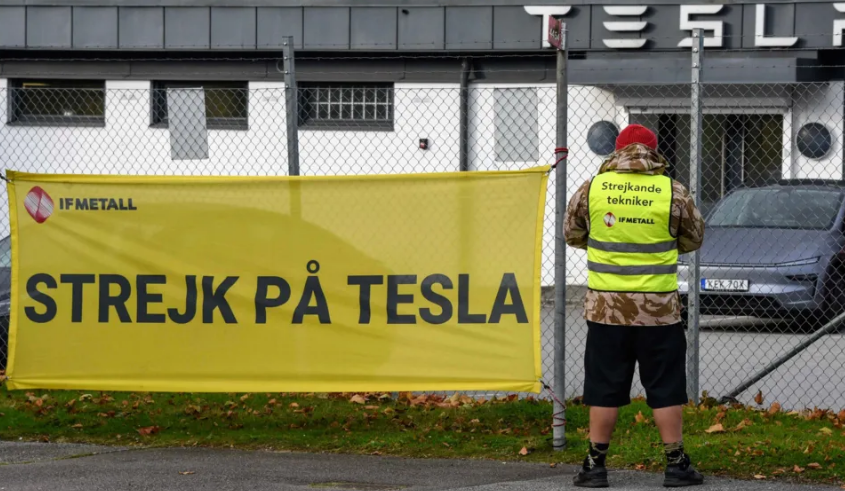
A bitter labour dispute between Tesla and Swedish car mechanics has reached its second year, with little sign of resolution. Around 70 mechanics at the US carmaker’s 10 service centres across Sweden continue to strike, standing firm against one of the world’s most powerful companies.
The strike, led by the trade union IF Metall, began on 27 October 2023, after repeated attempts to secure a collective bargaining agreement with Tesla failed. Such agreements, which allow unions to negotiate pay and working conditions on behalf of employees, have long been a cornerstone of Sweden’s labour model. Today, nearly 70% of Swedish workers are union members, and 90% are covered by collective agreements.
For mechanics like 39-year-old Janis Kuzma, the struggle has been grueling. Each Monday, Kuzma joins a fellow worker on the picket line outside Tesla’s Malmö service centre, braving Sweden’s freezing winter temperatures. “It’s a tough time,” he admits, though the union provides basic support, including shelter in a mobile van, coffee, and sandwiches.
Inside the garage, however, operations appear to continue largely uninterrupted. Tesla has replaced striking mechanics with new workers — a move legal under Swedish law but one that breaks decades of industrial norms. “Tesla has done it openly and systematically,” says researcher German Bender from the union-backed think tank Arena Idé. “It goes against all established practices, but Tesla doesn’t care about norms — they see being a norm-breaker as a compliment.”
Tesla’s CEO Elon Musk has made his opposition to unions clear, saying in 2023 that unions “create negativity in a company.” Meanwhile, Tesla’s Swedish subsidiary, TM Sweden, insists the decision not to sign a collective agreement was made locally. In a rare interview with Dagens Industri earlier this year, TM Sweden’s country lead Jens Stark said the company preferred to “work closely with the team” rather than negotiate through a union.
The strike has drawn solidarity across the Nordic region. Dockworkers in Denmark, Norway, and Finland have refused to handle Tesla shipments, while waste collectors and electricians in Sweden are boycotting the company’s facilities and charging stations.
Yet, Tesla owners appear largely unaffected. “We can still buy, service, and charge our cars,” says Tibor Blomhäll, president of Tesla Club Sweden.
For IF Metall, the dispute is about more than wages — it’s a fight for the future of Sweden’s collective bargaining system. “If Tesla can ignore our agreements, others might follow,” warns union president Marie Nilsson.
With both sides entrenched, analysts predict the standoff could drag on indefinitely. As Bender puts it, “Tesla sees negotiation as submission — not discussion.” For the mechanics on Sweden’s frozen picket lines, that means the battle is far from over.
