


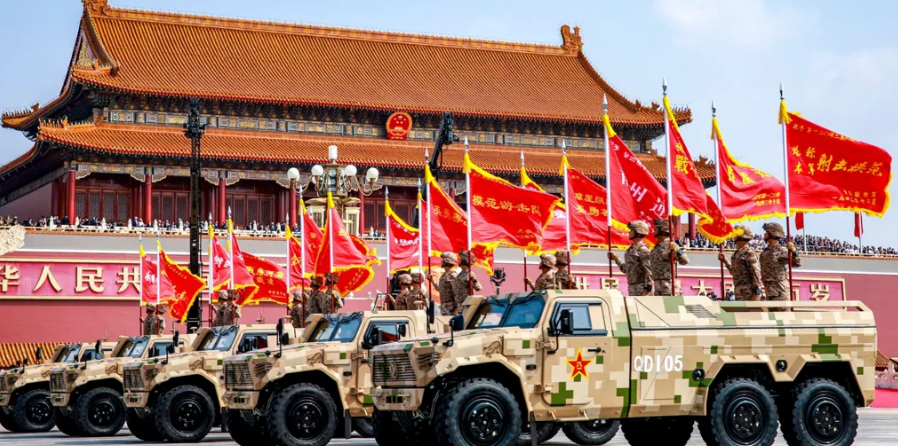
China showcased its expanding military strength on Wednesday in a sweeping parade at Beijing’s Tiananmen Square, marking the 80th anniversary of the end of World War Two. The display of advanced weaponry and tightly choreographed formations sent a pointed signal to the world — and to Washington.
Thousands of miles away, US President Donald Trump confirmed he was watching closely. “They were hoping I was watching, and I was watching,” he told reporters during a meeting with Polish President Karol Nawrocki at the White House. Trump called the event “very, very impressive” but offered little further comment.
The parade, attended by Russian President Vladimir Putin, North Korean leader Kim Jong Un and over two dozen other world leaders, underscored Beijing’s ambitions to position itself as a central force in reshaping the global order. Analysts say it was both a reminder of China’s growing military capabilities and a deliberate attempt to reframe its role in World War Two, portraying itself as a decisive power in the defeat of fascism and imperialism.
“Rewriting history is the first step in rewriting the rules of the road,” said Richard Wilkie, former US secretary of veterans affairs. He noted that China’s communist forces played a limited role in Japan’s defeat compared with US and nationalist Chinese troops.
Trump’s Shifting Tone
Trump’s own response to the spectacle reflected a familiar blend of admiration for military pageantry and grievance toward Beijing. In a podcast on Tuesday, he downplayed the significance of the event, saying he was “not concerned.” Hours later, on his Truth Social platform, he accused China of failing to credit the US for its role in World War Two, pointedly addressing his message to Putin and Kim.
Trump has long expressed enthusiasm for military parades. In recent months, he welcomed Putin to Alaska with a bomber flyover and hosted a US Army anniversary parade in Washington featuring World War Two tanks and historical reenactments — a contrast to Beijing’s futuristic arsenal on display.
Global Alignments Shifting
The parade capped a week of diplomatic maneuvers in China, where President Xi Jinping and Putin met with Indian Prime Minister Narendra Modi at an economic summit in Tianjin. Their talks suggested warming ties between China and India, strained in recent years but now easing in part due to US tariff policies that have disrupted global trade.
Trump’s “America First” approach has unsettled longstanding economic and diplomatic relationships. He argues tariffs are essential to protect US industry and raise federal revenue, but critics warn they are driving rival powers closer together.
Adding to Trump’s challenges, a US appellate court ruled last week that many of his tariffs were improperly imposed. The president has vowed to appeal to the Supreme Court, though the justices have previously pushed back against presidents who expand executive authority without congressional approval.
For now, Trump insists his strategy will usher in “a second American golden age.” But as Beijing projects power abroad and legal battles mount at home, the risks surrounding his unorthodox approach remain high.
