


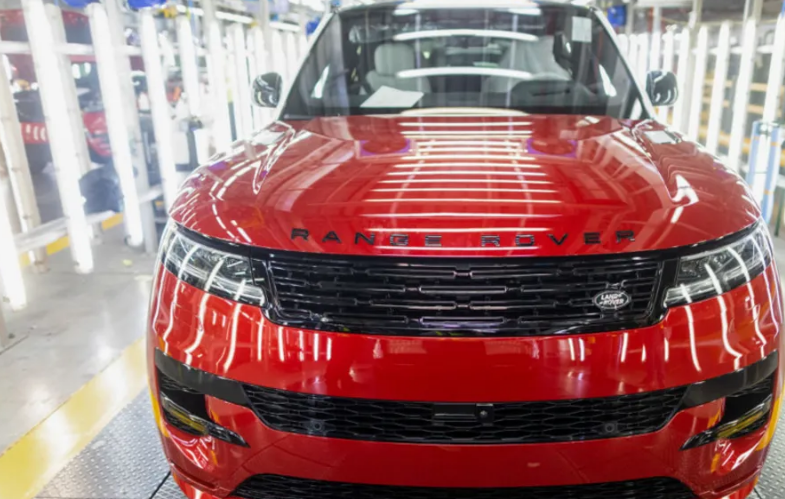
Jaguar Land Rover (JLR) has announced plans to cut up to 500 management jobs in the UK through a voluntary redundancy scheme, as the carmaker grapples with falling sales and mounting pressure from US trade tariffs.
The move, which affects no more than 1.5% of JLR’s British workforce, comes after the company reported a decline in sales during the quarter ending in June. The drop was attributed to export disruptions caused by US tariffs and the planned phase-out of older Jaguar models.
Describing the redundancies as “normal business practice,” JLR said it regularly offers voluntary redundancy to eligible employees and that this latest round reflects the business’s evolving operational needs.
The job cuts come on the heels of US President Donald Trump’s decision to impose a 10% tariff on British car exports to the United States—an increase from the previous 2.5%. Although a new UK-US trade deal capped the tariff at 10% for the first 100,000 British vehicles exported annually, the higher rate has already taken a toll on JLR, prompting it to pause shipments to the US market.
“Tariffs play a big role in this decision,” said Professor David Bailey from Birmingham Business School, noting that JLR had only recently posted a £2.5 billion profit in the year ending March—its best performance in a decade. “The firm has also been hiring for its electric vehicle production, but tariffs have certainly disrupted plans.”
One of JLR’s top-selling models, the Defender, is built in Slovakia and continues to face a steep 27.5% tariff, further complicating the company’s export strategy.
Despite the headwinds, JLR said the trade agreement gave it enough confidence to continue investing £3.5 billion annually in its operations. The company, which employs over 30,000 people in the UK, has major facilities in Solihull, Wolverhampton, and Halewood, and builds a range of premium SUVs including the Range Rover.
Downing Street dismissed any suggestion that the cuts reflect poorly on Prime Minister Sir Keir Starmer, who visited JLR in May and pledged support for the UK car industry. A government spokesperson said the trade deal was “jobs saved, not job done” and that the company’s decision reflected “challenging global conditions.”
Labour MP Preet Kaur Gill echoed the government’s stance, saying the recent trade agreement had already helped protect thousands of jobs. “Jaguar Land Rover is a key employer in my region, and we’re committed to supporting its long-term stability,” she said.
