


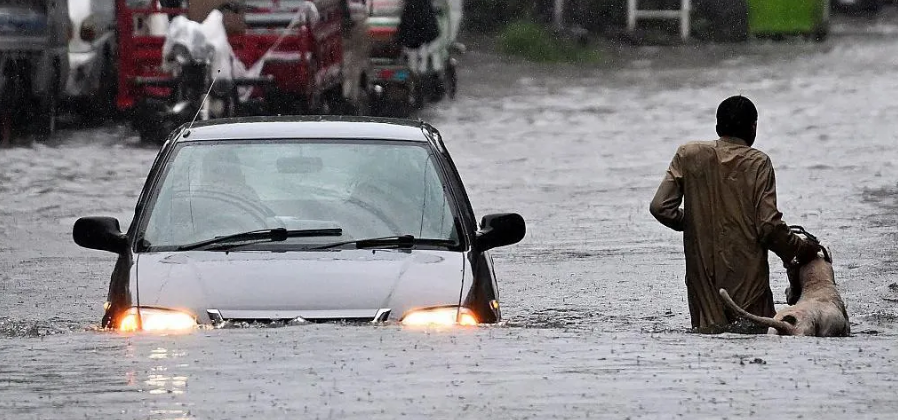
At least 63 people have died and nearly 300 others were injured in Pakistan’s Punjab province over the past 24 hours, as relentless monsoon rains triggered widespread destruction, the National Disaster Management Authority (NDMA) said on Thursday.
The heavy downpours began early Wednesday, causing widespread flooding, building collapses, and infrastructure damage across the province. Most of the fatalities occurred due to collapsing structures, while others drowned or were electrocuted in floodwaters, according to NDMA officials.
Authorities in Rawalpindi, located adjacent to the capital Islamabad, declared Thursday a public holiday in an effort to keep residents indoors. People living near the banks of the Leh Nullah, a river that swells during the monsoon, were ordered to evacuate as water levels rose dangerously.
The latest casualties bring Pakistan’s nationwide monsoon death toll to nearly 180 since the rainy season began in late June, with children accounting for more than half of the victims. The floods have severely disrupted life in Punjab, shutting down expressways and forcing the cancellation or delay of dozens of flights.
Punjab Chief Minister Maryam Nawaz declared a state of emergency in affected areas on Thursday, assuring the public that government institutions were “working with utmost effort.” She urged residents to follow safety advisories to minimize further loss of life.
In Chakwal, a city that received an extraordinary 400mm of rainfall in a single day, emergency teams deployed boats and helicopters to rescue stranded residents. Social media footage showed waist-deep floodwaters inundating homes and streets, while helicopters circled overhead in search-and-rescue operations.
The Pakistan Meteorological Department has forecast continued rains and potential flash floods through the weekend. Thousands of emergency workers across the province remain on high alert.
Pakistan, home to nearly 250 million people, is one of the world’s most climate-vulnerable countries. The South Asian nation is affected by two opposing weather systems—one driving extreme heat and drought, and the other bringing intense monsoon rainfall.
Additionally, Pakistan hosts over 13,000 glaciers, which scientists warn are melting rapidly due to rising global temperatures, compounding the risk of glacial lake outburst floods.
The country is still recovering from the catastrophic floods of 2022, which submerged a third of the nation, killed 1,700 people, and caused over $30 billion in damages. In 2023, UN Secretary-General António Guterres called on the international community to support Pakistan, describing it as “doubly victimised” by climate change and an inequitable global financial system.
