


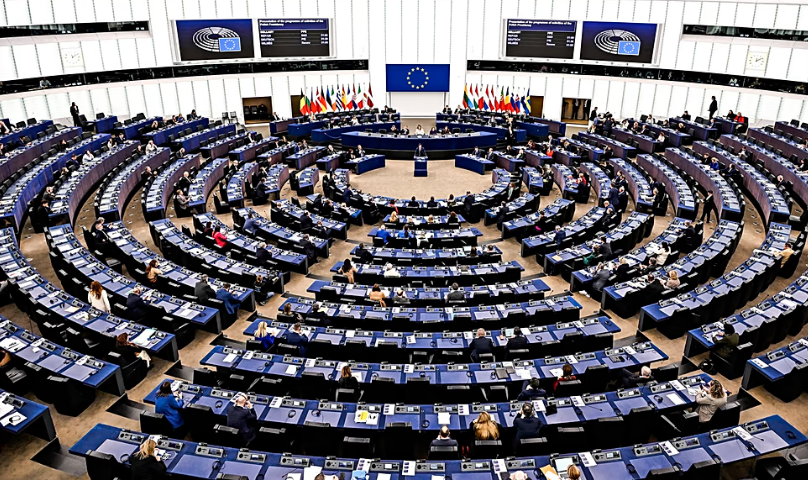
For the first time in its history, the European Parliament is witnessing the rise of a potential right-wing majority, as the European People’s Party (EPP) increasingly collaborates with hard-right groups previously considered untouchable. The shift is testing the influence of centrist forces and creating a complex situation for Commission President Ursula von der Leyen.
This week’s plenary session highlighted that the traditional centrist alliance, which has long dominated European politics, no longer holds unchallenged sway. The EPP now faces a strategic choice: continue working with its pro-European, progressive allies or court the hard-right European Conservatives and Reformists (ECR), Patriots for Europe (PfE), and Europe of Sovereign Nations (ESN).
The shift was evident in the passage of a corporate sustainability bill, known as the “Omnibus I” package. The law, aimed at simplifying EU due diligence rules, initially stalled with centrist parties over environmental and social concerns. The EPP turned to the right, securing support from ECR, PfE, and ESN to pass measures that limit regulatory obligations to large corporations and reduce potential fines.
Swedish MEP Jörgen Warborn, rapporteur for the bill, said the EPP’s amendments were supported exclusively by right-wing parties, illustrating a strategy outlined by EPP Chair Manfred Weber: avoid formal alliances with the far right but rely on their votes when necessary. The EPP argues that if progressive groups showed more flexibility, such cross-party support would be less critical.
The rise of the “Venezuela majority,” first seen in 2024 when EPP lawmakers joined hard-right parties to recognize opposition leader Edmundo González as Venezuela’s president, signals a recurring pattern. Similar alignments have influenced EU deforestation laws, the Sakharov Prize, and transparency rules for NGOs, raising concerns about the growing influence of the right.
Despite these shifts, the EPP continues to vote with centrist parties on many critical issues, including no-confidence motions and key budget decisions. Still, the emergence of a right-wing bloc has the potential to sway controversial legislation on topics such as the Green Deal, migration policies, and EU asylum directives, which are increasingly dividing centrist factions.
For Ursula von der Leyen, the trend presents a dilemma. Since her first term in 2019, she has relied on a pro-European centrist majority to advance her agenda. She campaigned on a promise to work only with parties supporting the EU, rule of law, and Ukraine, yet the current fragmentation has forced her to balance progressive priorities with the growing influence of right-leaning member states.
Von der Leyen has cultivated relationships with leaders such as German Chancellor Friedrich Merz, Italian Prime Minister Giorgia Meloni, and Polish Prime Minister Donald Tusk, aligning her proposals with the political right while still trying to maintain progressive support. Her approach reflects the broader reality of a European Parliament that is less predictable and more polarized than ever.
The rise of a right-wing majority could reshape EU policymaking over the next five years, challenging long-standing centrist coalitions and altering the legislative landscape at a crucial moment for Europe.
