


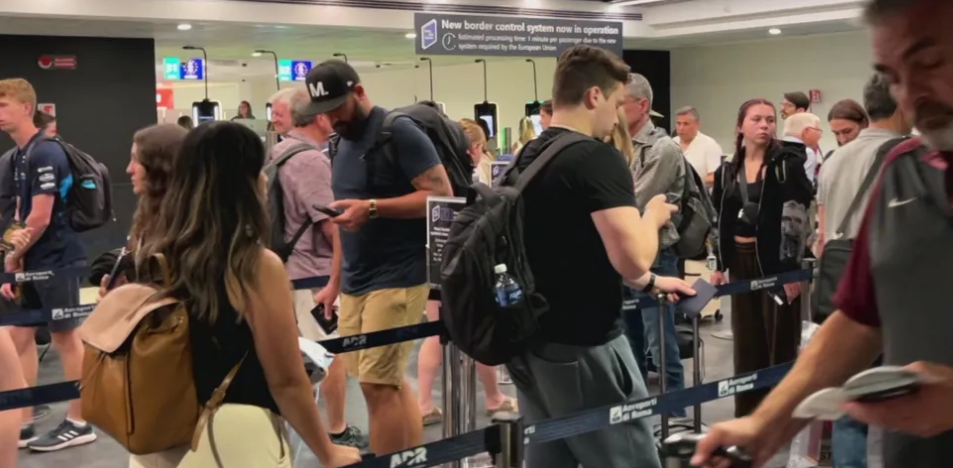
British travellers heading to Europe this summer are being warned to expect longer waits at passport control as the European Union’s Entry/Exit System (EES) continues to cause delays at airports across the Schengen area.
The warning comes after Ryanair advised passengers to allow extra time for their journeys, while airport officials in Italy and Portugal acknowledged that the new digital border system has increased processing times despite recent improvements.
The EES, introduced gradually since October, requires non-EU citizens entering the 29-country Schengen area to register their fingerprints and have a facial photograph taken on arrival. The information is then verified when they leave the bloc. The process is carried out through automated kiosks or by border officers, with children below the eligible age processed manually.
Ivan Bassato, Chief Aviation Officer at Rome’s Fiumicino Airport, said changes had improved passenger processing but acknowledged the system still takes much longer than the previous passport checks.
According to Bassato, UK travellers previously spent about seven minutes clearing passport control, but the average has now risen to around 20 minutes, even after integrating biometric checks into electronic passport gates.
“We are not at the point where you have the same quality of the process as before the EES,” he said, adding that waiting times of one to two hours remain unacceptable for an airport that prides itself on efficiency.
Bassato said authorities should simplify parts of the process and expand the use of the EU’s pre-registration application, which is currently being used only by Sweden and Portugal.
Travellers have reported lengthy delays at several European airports. Carl, who travelled from Yorkshire to Rome with his family, said it took two hours to clear passport control after landing.
“I knew it was going to be bad, but not as bad as that,” he said.
Other visitors described similar experiences. A traveller arriving in Barcelona said the queue lasted nearly an hour because several biometric machines were not operating, while another said passport control took almost as long as the flight itself.
At Portugal’s Faro Airport, border police also confirmed that technical issues have affected the rollout. Superintendent Pedro Oliveira said the system occasionally experiences software problems linked to central European servers, causing temporary disruptions.
He explained that queues which once lasted about 10 minutes can now exceed 30 minutes, although waits of more than an hour remain uncommon. According to Oliveira, system crashes affecting multiple member states have become less frequent, and additional border officers have been deployed to help reduce delays.
The European Commission said disruption remains limited at most airports and pledged to continue supporting member states as the system is introduced across the bloc.
Despite those assurances, airlines and airport operators have urged EU authorities to provide greater flexibility during peak travel periods. Industry representatives have requested permission for countries to temporarily suspend parts of the EES during exceptionally busy times, but no policy changes have been approved.
With millions of holidaymakers travelling during the summer season, passengers are being encouraged to arrive at airports earlier than usual and allow additional time for border formalities until the new system becomes fully established.
