


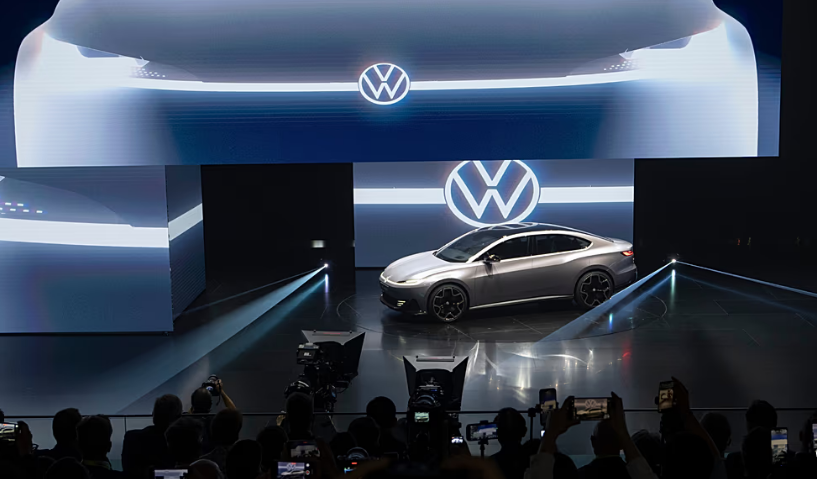
Volkswagen is making a major push in China, developing vehicles specifically tailored to Chinese consumers in an effort to regain lost market share. The German automaker’s new strategy reflects a shift from its traditional approach of producing models overseas and adapting them for the Chinese market.
The company has invested €3 billion in a research and development hub in Hefei, a city of 10 million in central China. This is Volkswagen’s largest R&D center outside Germany and marks a significant commitment to designing cars for local tastes. Many of these vehicles are unlikely to appear on European roads but may eventually be exported to the Middle East and Southeast Asia.
“This business model is now gone,” said Thomas Ulbrich, chief technology officer of Volkswagen Group China, referring to the old approach of relying on foreign-developed vehicles. In 2022, Volkswagen began overhauling its operations in China, focusing on designing and producing cars that match local consumer preferences.
The shift comes as Volkswagen faces stiff competition from domestic rivals such as BYD and Geely. Chinese automakers have rapidly gained market share, driven by electric vehicles (EVs), digital features like large touchscreens, and autonomous driving capabilities. Traditional Volkswagen models no longer resonate with a market that now accounts for roughly a third of the company’s global sales.
Audi, part of the Volkswagen Group, has already launched a new sub-brand this year, while Volkswagen plans to introduce new 2026 models developed entirely in China. “It’s a million-dollar question whether this strategy will pay off,” said Claire Yuan, director of corporate ratings for China autos at S&P Global Ratings. “We have to monitor, but I think they are on the right track of catching up in the race.”
Foreign automakers historically fell behind because new vehicles took three to five years to develop, while Chinese firms release cars within 12 to 18 months. The pace, known as “China speed,” has become essential for survival in the highly competitive market, said Bill Russo, CEO of Shanghai-based consultancy Automobility.
Volkswagen is also collaborating with Chinese EV startup Xpeng to accelerate model development and create its own electronic architecture, the system that controls a car’s functions. Local teams have been given greater decision-making power, allowing them to act quickly on design and technology choices.
The shift highlights a broader trend: foreign automakers are learning from Chinese companies as much as the other way around. Knowledge transfer is now a two-way street, said Martin Hofmann, a Volkswagen executive and chair of the German Chamber of Commerce in North China. A recent survey of 600 chamber members found that half expect Chinese competitors to become global innovation leaders within five years.
Volkswagen’s strategy in China represents both a major gamble and a potential blueprint for other foreign automakers seeking to remain competitive in the world’s largest auto market. The success of the Hefei-designed models will determine whether Volkswagen can reclaim its position among the top players in China’s fast-evolving automotive landscape.
