


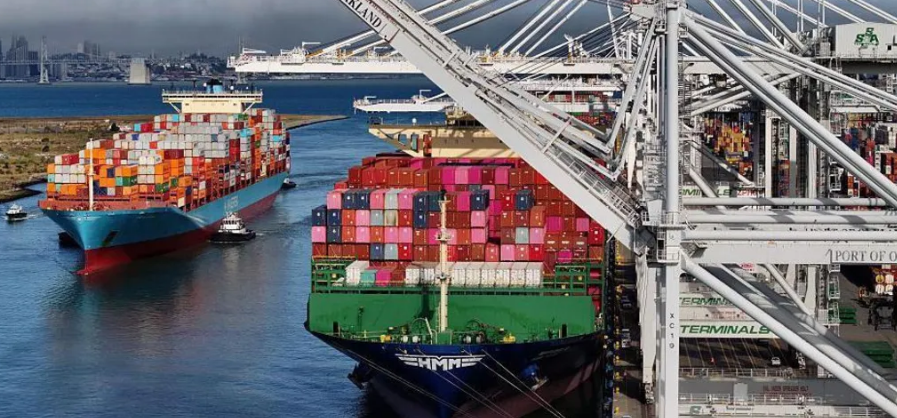
A new wave of sweeping tariffs imposed by U.S. President Donald Trump officially took effect this week, impacting more than 90 countries and prompting a flurry of last-minute trade negotiations around the world.
The revised import tax policy—dubbed “reciprocal tariffs” by the Trump administration—is part of the president’s broader effort to overhaul the global trading system, which he has long claimed disadvantages the United States. Just before the implementation deadline, Trump took to his Truth Social platform to declare that “billions of dollars” were now flowing into the U.S. thanks to the new tariffs.
Among the most high-profile moves was a 50% tariff imposed on India, set to take effect on August 27 unless New Delhi halts its purchases of Russian oil. Additionally, Trump has threatened a 100% tariff on foreign-made semiconductors, a move widely seen as an effort to pressure tech firms into investing in U.S. manufacturing.
Apple, which has faced mounting pressure from the White House, responded by announcing a $100 billion investment in its American operations—a move that could ease tensions with the administration.
Countries Scramble to Strike Last-Minute Deals
Ahead of the August 7 deadline, countries rushed to reach agreements with Washington to avoid the full brunt of the new tariffs. The UK, Japan, and South Korea have already secured preferential rates through bilateral negotiations. The European Union also reached a framework deal, accepting a 15% tariff on EU-origin goods.
However, others have not been as successful. Switzerland, which failed to strike a deal in time, now faces a steep 39% tariff—one of the highest imposed—and has called an emergency meeting to assess the economic fallout. Taiwan, a close U.S. ally, was handed a 20% tariff, though President Lai Ching-te described the measure as “temporary” amid ongoing talks.
Asia Hit Hardest as Stock Markets React
Southeast Asian economies—particularly export-dependent nations like Laos and Myanmar—were among the worst affected, with tariffs as high as 40%. Analysts note that many of the targeted countries have strong trade links with China, a continuing focal point of Trump’s trade policies.
Despite the sweeping measures, markets in Asia showed relative calm. Major indexes in Japan, Hong Kong, South Korea, and mainland China posted slight gains, while markets in India and Australia dipped.
North American Neighbors Caught in Crossfire
Canada saw its tariff rate rise from 25% to 35% last week, as Trump accused Ottawa of not doing enough to stem the flow of fentanyl and other narcotics across the U.S. border. However, most Canadian exports remain shielded under the United States-Mexico-Canada Agreement (USMCA).
Meanwhile, increased tariffs on Mexican goods were delayed for 90 days as negotiations continue.
Economists say the implementation of the full tariff list could bring some clarity after months of uncertainty. “This is supposed to be it,” said Bert Hofman of the National University of Singapore. “Now you can start to analyse the impact of the tariffs.”
Still, with trade talks ongoing and geopolitical tensions simmering, businesses and investors are likely to remain cautious in the months ahead.
