


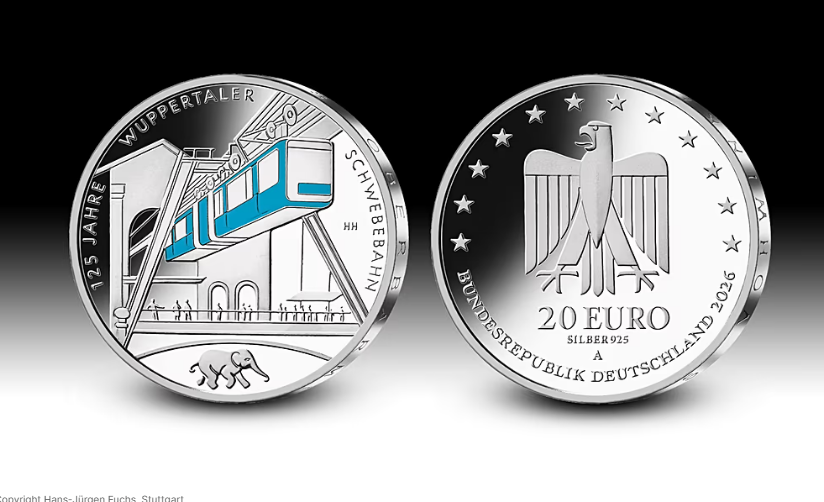
Germany has temporarily suspended the release of two commemorative silver coins after a sharp rise in global silver prices made their production uneconomical, the Federal Ministry of Finance announced this week. The decision, which interrupts a long-standing national tradition of minting collector coins, underscores how volatile commodity markets can disrupt even cultural mainstays.
The Bundesbank confirmed that two highly anticipated issues — a €25 coin featuring the Heilige Drei Könige (Holy Three Kings) and a €20 coin marking “125 Years of the Wuppertal Suspension Railway” — have been postponed indefinitely. The coins were originally scheduled for release in November and January, respectively.
The problem lies in the soaring cost of silver, which has surged around 65 percent since January. The increase means the silver used to mint each coin now costs more than the coin’s face value, making production financially unsustainable.
“While collector coins have always been a source of national pride, the current economics simply don’t add up,” a finance ministry spokesperson said.
Silver, though experiencing a milder rally than gold, has seen demand climb due to its dual role as both an investment and an industrial metal. It is widely used in technologies such as solar panels, semiconductors, and electric vehicles, where its high conductivity makes it indispensable. Geopolitical uncertainty has also pushed investors toward precious metals, driving up prices further.
Germany’s collector coins, while legal tender, are not intended for everyday use. Typically sold slightly above their nominal value, they generate revenue for the government through what economists call seigniorage — the difference between a coin’s face value and its production cost. When the cost of silver spikes, however, that profit quickly vanishes.
Despite the temporary pause, the Finance Ministry has reassured collectors that not all upcoming releases are affected. Future commemorative coins remain on the minting calendar, including a €25 coin honouring Elisabeth Schwarzhaupt, Germany’s first female cabinet minister, and another celebrating 150 years of the Richard Wagner Festival in Bayreuth.
Officials are now exploring options to adjust the metal composition of the coins to reduce losses while maintaining their high-quality finish.
Germany is among the few eurozone nations that still issues pure-silver legal tender coins, which often celebrate the country’s cultural and scientific achievements. Past releases have paid tribute to figures such as Johann Wolfgang von Goethe, Albert Einstein, and Pope Benedict XVI.
The ministry’s move highlights how fluctuations in global commodity prices can ripple through even the most traditional and symbolic aspects of national heritage — leaving a pause in a minting legacy that has spanned decades.
