


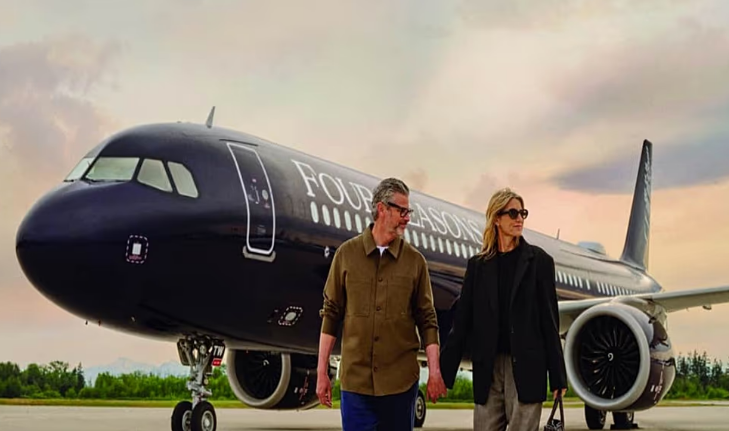
High-net-worth travellers are increasingly turning away from traditional luxury holidays and toward highly exclusive, hyper-personalised experiences that prioritise access, privacy and rarity over ownership. According to the World Luxury Chamber of Commerce’s 2026 Travel Trends Report, the global elite are reshaping tourism by seeking out destinations and journeys far removed from mass travel and crowded hotspots.
One of the most visible expressions of this shift is the rise of curated private jet expeditions. Companies such as Four Seasons now offer fully planned around-the-world itineraries lasting up to 24 days. These trips, operated on customised Airbus A321neo-LR aircraft with fewer than 52 seats, include flatbed leather seating, onboard fine dining prepared by a private chef, and dedicated concierge services. Destinations span Bora Bora, Kyoto, the Serengeti, Easter Island and the Maldives, with immersive experiences ranging from cultural workshops to guided expeditions. Packages start at around $219,000 (€187,000) per person and include accommodation, meals and ground transport.
At the highest end of exclusivity, private island rentals continue to attract ultra-wealthy travellers seeking complete seclusion. Islands such as Banwa Private Island in the Philippines, Laucala Island in Fiji, and Calivigny Island in Grenada offer full privacy with luxury villas, infinity pools and personalised staff. Richard Branson’s Necker Island and Musha Cay in the Bahamas also remain popular, offering tailored experiences including private dining on sandbars and bespoke entertainment. Nightly rates range from $46,000 (€39,000) to over $100,000 (€85,000), depending on the destination.
Adventure tourism has also reached new extremes with the emergence of space travel for civilians. Companies such as Blue Origin and SpaceX now offer suborbital and orbital flights. Blue Origin’s brief missions provide minutes of weightlessness above the Kármán line, while SpaceX’s Crew Dragon offers multi-day orbital stays with luxury interiors and panoramic views of Earth. Ticket prices can reach $55 million (€46.9 million) per passenger.
Polar tourism is another fast-growing segment, with ultra-luxury expeditions to Antarctica and the Arctic gaining popularity. Operators like White Desert fly guests directly from Cape Town to remote camps inside Antarctica, where high-end pods, gourmet dining and guided exploration replace traditional cruise infrastructure. Experiences include visits to emperor penguin colonies and the South Pole, with prices starting around $16,000 (€13,600) for short trips and exceeding $70,000 (€60,000) for extended journeys.
In the cruise sector, multi-month global voyages are drawing increasing interest. Regent Seven Seas and similar operators offer itineraries lasting over 140 days, combining all-suite accommodation, fine dining, wellness facilities and curated excursions across dozens of countries.
The evolution of luxury travel reflects a broader shift in elite tourism, where exclusivity, privacy and once-in-a-lifetime access define the new standard of global exploration.
