


A decades-old dream of capturing solar energy in orbit and beaming it down to Earth is edging closer to reality, as companies in the US, UK, China and beyond accelerate efforts to turn space-based solar power into a viable energy source.
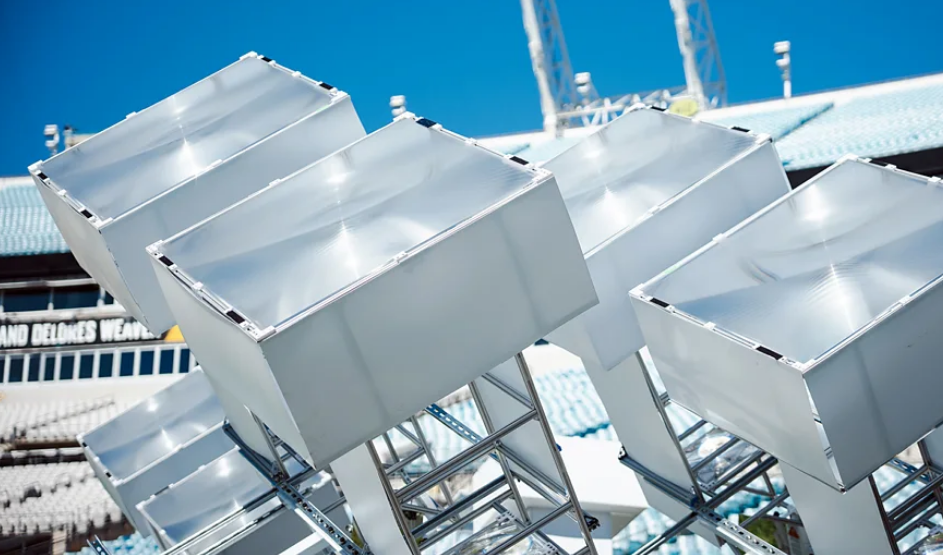
In March, a Florida-based firm called Star Catcher conducted a striking experiment at the Jacksonville Jaguars’ American football stadium. Instead of footballs, beams of concentrated sunlight crossed the field — transmitted from a 1.2-metre-tall lens on one side to a receiver on the other. “We beamed 100 watts about 105 metres,” said Andrew Rush, Star Catcher’s chief executive. The test was part of a broader effort to explore how solar energy could be collected in space and transmitted wirelessly to power satellites or, eventually, homes on Earth.
The concept of space-based solar power (SBSP) has fascinated scientists for decades. Solar panels in orbit can capture sunlight 24 hours a day, unaffected by weather or Earth’s atmosphere, which reflects and absorbs much of the Sun’s radiation. Advocates say it could one day deliver vast amounts of clean energy — potentially enough to meet up to 80% of Europe’s renewable power needs, according to UK firm Space Solar.
“Space-based solar power makes the energy transition work,” said David Homfray, Space Solar’s co-founder. His company envisions building giant orbital stations that beam electricity to Earth via radio waves. Space Solar’s proposed Cassiopeia project — a 1.8-kilometre-wide structure in geostationary orbit — could generate 700 megawatts, enough to power half a million homes.
The technology, however, faces daunting challenges. Building such enormous systems would require hundreds of rocket launches, advanced robotics and global coordination. Critics also point to cheaper renewable alternatives that could be deployed more quickly to combat climate change.
Yet momentum is building. Falling launch costs, driven by rockets like SpaceX’s Starship, have made the idea more practical. Governments and militaries are investing, too. The UK awarded £4.3 million in 2023 to SBSP projects, while China’s Omega 2.0 prototype is testing microwave power transmission. In the US, start-up Aetherflux recently raised $50 million to develop infrared laser satellites that could beam power to small ground stations by 2026.
“It’s a lot closer to reality than people think,” said Michelle Hanlon, a space law expert at the University of Mississippi. “Once you make that initial investment, that power is literally free.”
Still, questions remain about cost, safety and scalability. Critics warn of the risks posed by launching thousands of satellites and the potential for interference with other space systems. Others argue the high initial expense may outweigh the benefits — at least for now.
But supporters say the long-term potential is too great to ignore. “We’re reaching a critical mass point,” said Mike Curtis-Rouse of the UK’s Satellite Applications Catapult. “Within the next two decades, space-based solar could move from science fiction to the foundation of clean global power.”
