


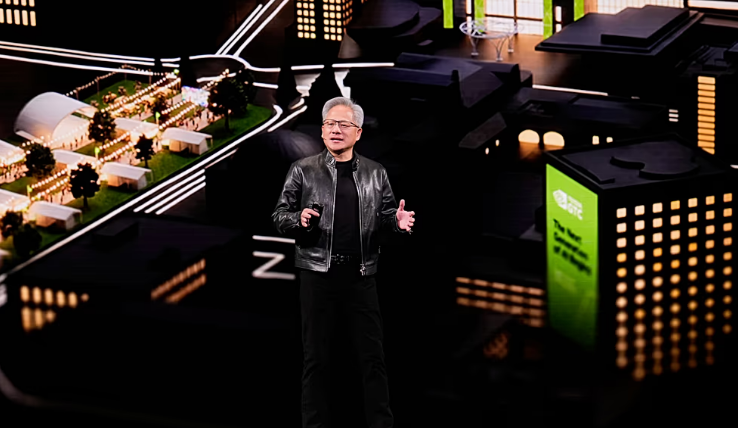
At its annual conference in San Jose, California, Nvidia CEO Jensen Huang outlined a sweeping vision for artificial intelligence (AI), autonomous vehicles, and space computing, presenting a series of innovations designed to expand AI applications from the cloud to city streets and even into orbit.
Huang highlighted three major developments. First, NemoClaw, an open-source platform for AI agents, aims to give businesses secure and autonomous software tools. AI agents can perform tasks independently, from managing calendars to interacting on digital platforms. NemoClaw builds on OpenClaw, previously developed by Austrian software engineer Peter Steinberger, and addresses past security concerns, including the sharing of sensitive financial and employee data. Huang encouraged companies worldwide to adopt OpenClaw strategies, calling it a transformative step for enterprise computing.
In the space sector, Nvidia introduced the Space-1 Vera Rubin Module, a GPU and computer designed for orbit-based data centres. The module is expected to deliver up to 25 times more computing power than existing chips, enabling advanced AI tasks, including training large language models, directly in space. By processing data onboard, satellites and space instruments can reduce the delay of sending information back to Earth. Huang noted that building functional space data centres remains complex, particularly in terms of cooling systems for the high-performance chips. Additional innovations, including the radiation-approved IGX Thor robotics technology, allow real-time AI processing and autonomous operations for satellites.
On the autonomous vehicle front, Nvidia announced a partnership with European rideshare company Bolt to deploy Level 4 robotaxis capable of operating without human intervention. Bolt will leverage Nvidia’s AI tools and sensor data from lidar, cameras, and radar to recreate realistic driving scenarios across Europe. The partnership aims to maintain European leadership in autonomous mobility while keeping control over data and technology. Bolt plans to bring 100,000 autonomous vehicles to its fleet by 2035 and has already conducted partnerships with companies such as Pony.AI and Stellantis. Huang also revealed collaborations with automakers including BYD, Hyundai, Nissan, Geely, and Uber to support robotaxi deployment.
“The ChatGPT moment of driving cars has arrived,” Huang said, emphasizing the potential of autonomous vehicles to transform urban mobility.
The announcements reflect Nvidia’s strategy of integrating AI across multiple sectors, from enterprise software to renewable energy, transportation, and space. By combining increased computing power with autonomous systems, the company is positioning itself at the forefront of a new era of AI-driven technology.
Nvidia did not provide a release date for the Space-1 Vera Rubin Module, stating only that it will be available at a later date, while the Bolt autonomous vehicle trials are scheduled to begin in European cities in 2026.
