


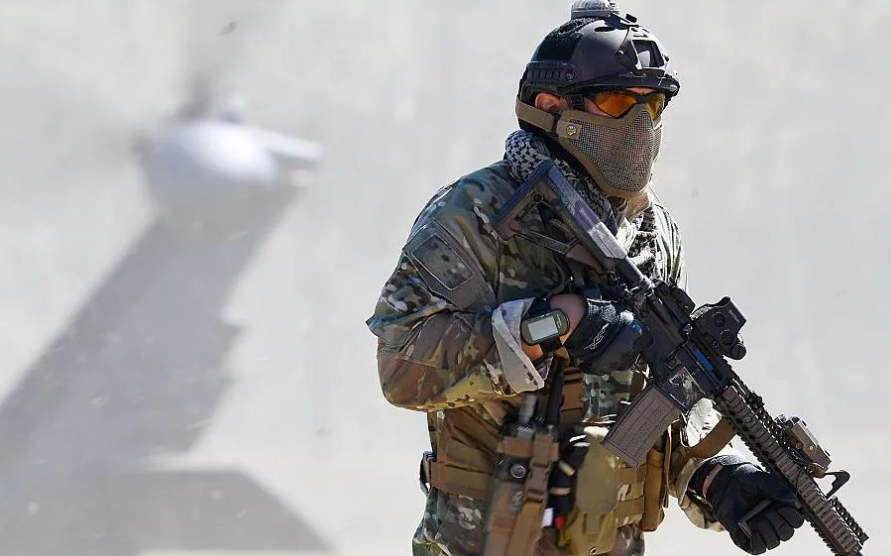
Early reports suggest the pilot of a US F-15 fighter jet downed over Iran has been rescued, with the search continuing for a second crew member, according to CBS News. The operation, taking place deep inside Iranian territory, reflects the complexity and urgency of combat search-and-rescue (CSAR) missions, a specialty of US military forces.
CSAR operations aim to locate, aid, and extract personnel in hostile or contested environments, unlike conventional rescue missions that typically occur in civilian or humanitarian contexts. In this case, verified video from Friday showed US military helicopters and at least one refuelling aircraft operating over Khuzestan province, underlining the high stakes and time-sensitive nature of the mission.
Former pararescue squadron commander, speaking to CBS, described the mission as “harrowing and massively dangerous,” involving at least two dozen pararescue jumpers deployed in Black Hawk helicopters. These teams are trained to provide medical aid, evade enemy forces, and coordinate extraction. Jonathan Hackett, a former US Marine Corps Special Operations specialist, told the BBC that CSAR teams often work backwards from the last known location of missing personnel, adjusting for terrain and mobility constraints. He also noted that indigenous contacts in the area could play a role in contingency planning for recovery operations.
CSAR missions have a long history in US military operations. The first helicopter rescue occurred in 1944 in Burma, where a US lieutenant extracted soldiers from behind Japanese lines. Modern CSAR evolved during the Vietnam War, with missions such as Bat 21 highlighting the risks and operational challenges involved. Lessons learned during that period helped shape current pararescue tactics, procedures, and coordination.
Pararescue jumpers, part of the US Air Force, are highly trained as combatants and paramedics. Their rigorous selection and training program, which can take up to two years, includes parachuting, diving, survival skills, resistance and escape training, and battlefield medicine. Teams are guided by Combat Rescue Officers who plan, coordinate, and execute recovery operations under extreme conditions. The official motto of pararescue teams is “These Things We Do, That Others May Live.”
Pararescue units have been active in recent conflicts, including Iraq and Afghanistan, performing thousands of rescue missions. Notable historical recoveries include the 1995 rescue of US pilot Scott O’Grady in Bosnia and the 1999 recovery of an F-117 pilot over Serbia. The mission in Iran, if successful, would mark the continuation of this legacy in high-risk environments.
The ongoing search for the second crew member underscores the dangers and unpredictability of such missions. US military sources emphasize that CSAR operations require precise coordination, extensive training, and readiness to operate behind enemy lines to save lives in the most challenging circumstances.
