


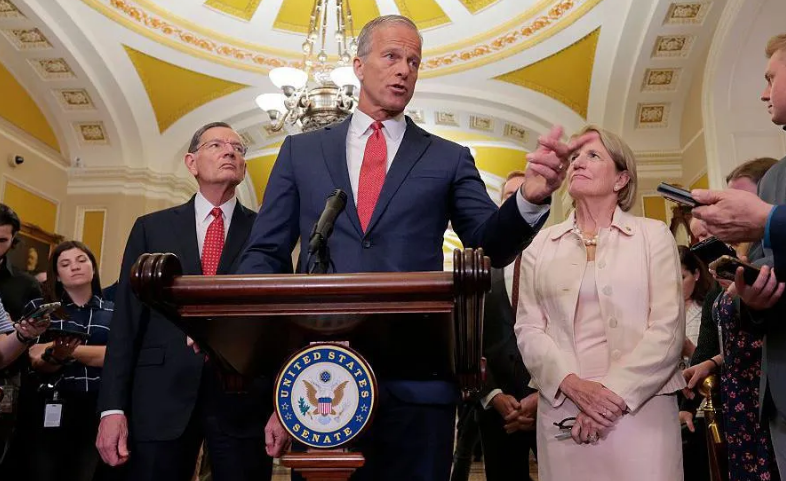
The US Senate is locked in a high-stakes legislative battle over President Donald Trump’s sweeping budget proposal, officially titled the “One Big Beautiful Bill Act.” As senators engage in a marathon “vote-a-rama” session — a grueling process of debating and voting on hundreds of amendments — deep divisions within Trump’s own Republican Party are threatening to derail a bill central to his economic agenda.
The proposed legislation would extend $3.8 trillion in Trump-era tax breaks, but it comes at a hefty price: an estimated $3.3 trillion increase to the national debt, which already stands at $36 trillion, according to the US Treasury. The Congressional Budget Office warns the proposed welfare cuts could also leave nearly 12 million Americans without health insurance.
The bill passed narrowly in the House of Representatives last month and is now under intense scrutiny in the Senate, where Republicans — who hold a slim majority — can only afford three defections. Should they lose that many votes, Vice-President JD Vance would be required to cast the tie-breaking vote. A final House vote on the amended Senate version is expected as early as Wednesday.
Key areas of contention centre on deep proposed cuts to welfare programmes like Medicaid in order to offset the cost of extending tax breaks. Two Republicans, including North Carolina Senator Thom Tillis, broke ranks with their party over the weekend, voting against opening debate. Tillis, who subsequently announced his retirement, accused colleagues of abandoning campaign promises.
“Too many elected officials are motivated by pure raw politics who really don’t give a damn about the people they promised to represent,” he said in a statement.
Libertarian-leaning Senator Rand Paul of Kentucky also voiced strong objections, slamming the bill’s impact on both the national debt and low-income Americans.
Amid the Senate gridlock, Democrats attempted to delay proceedings further by forcing clerks to read the entire 940-page bill aloud — a 16-hour move meant to draw attention to the scale of the legislation and its potential consequences.
Adding to the political storm is Elon Musk, who has intensified criticism of Republicans for backing what he calls the “biggest debt increase in history.” Musk, once a high-profile ally of Trump and former head of the Department of Government Efficiency (DOGE), hinted at forming a new political party if the bill passes.
“Republicans campaigned on fiscal responsibility, but this bill is anything but,” Musk wrote. Trump responded by accusing Musk’s companies of relying heavily on government subsidies, claiming, “Without subsidies, Elon would probably have to close up shop and head back to South Africa.”
While Trump remains optimistic the bill will land on his desk by July 4, pressure from fiscal conservatives in the House Freedom Caucus — who argue it adds $650 billion more to the deficit — continues to threaten its path forward.
