


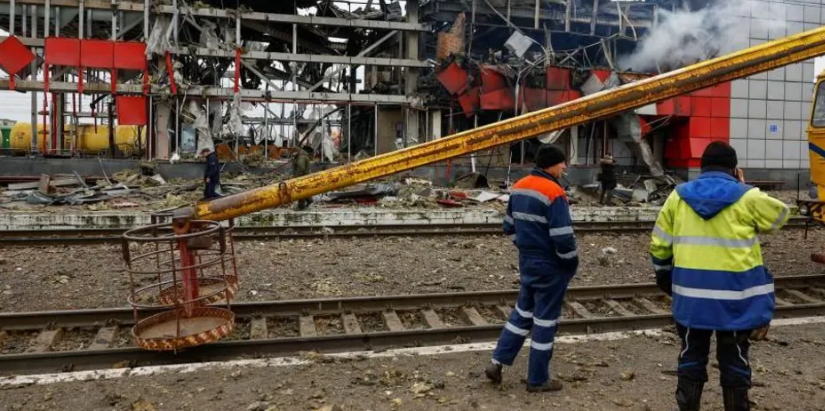
Russia carried out a large-scale aerial assault on Ukraine overnight, targeting key infrastructure as negotiations between the United States and Ukraine entered a third day in Florida. Ukrainian authorities reported that Moscow launched 653 drones and 51 missiles, most of which were intercepted by air defenses. One strike hit the railway hub in Fastiv, outside Kyiv, destroying the main station building and damaging rolling stock.
President Volodymyr Zelensky described the attack as “meaningless from a military point of view” and said Russia must have been aware of its lack of strategic impact. Ukrainian officials said the strikes focused on energy facilities across eight regions, causing widespread blackouts. The Zaporizhzhia nuclear power plant temporarily lost all external power overnight, marking the 11th such incident since Russia’s full-scale invasion.
The Russian defence ministry characterized the strikes as a “massive response” to alleged Ukrainian attacks on civilian targets. Ukrainian Foreign Minister Andrii Sybiha condemned the attacks, stating that Moscow continued to target critical civilian infrastructure and underlined the urgency of strengthening Ukraine and maintaining pressure on Russia.
In Florida, US special envoy Steve Witkoff and Rustem Umerov, secretary of Ukraine’s national security council, held two days of talks, which Witkoff described as “constructive.” The discussions focused on a framework for security arrangements and necessary deterrence capabilities to sustain a lasting peace, though specific details were not released. The negotiations, which also include US President Donald Trump’s son-in-law Jared Kushner, are scheduled to continue on Saturday.
Witkoff briefed the Ukrainian delegation on his recent five-hour meeting in Moscow with Russian President Vladimir Putin, where no compromise was reached on a draft US peace plan. While the Kremlin indicated that Putin is willing to meet as often as needed, Kyiv and its European allies remain skeptical of Russia’s commitment to ending the conflict.
Major sticking points in the talks include security guarantees for Ukraine and territorial concessions. Russia currently controls roughly one-fifth of Ukraine’s territory, including areas in Donetsk and Luhansk. Putin warned this week that Ukrainian forces must withdraw from the Donbas region or risk further military action.
Kyiv has pushed for revisions to the US peace plan, which was initially seen as favourable to Moscow, though an updated version has not been released publicly. Ukraine and its allies argue that the most effective long-term deterrence against future Russian attacks would include NATO membership or comprehensive security guarantees, a position strongly opposed by Russia.
The latest wave of attacks underscores the persistent tension on the ground even as diplomatic efforts continue. Officials in Kyiv stressed that the outcome of the negotiations depends on Moscow’s willingness to take tangible steps toward de-escalation and an end to hostilities.
