


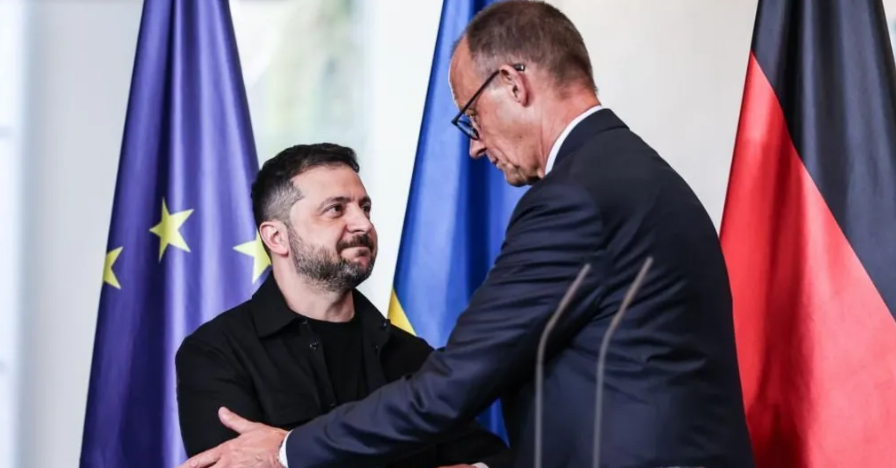
European leaders expressed cautious optimism on Wednesday after a virtual meeting with former U.S. President Donald Trump, just two days before his scheduled talks with Russian President Vladimir Putin in Alaska to discuss ending the war in Ukraine.
Trump reportedly told the group his main objective for the summit was to secure a ceasefire between Moscow and Kyiv. He also agreed that territorial matters should involve Ukrainian President Volodymyr Zelensky and that security guarantees must form part of any deal, according to French President Emmanuel Macron. Macron said the discussion helped “clarify [Trump’s] intentions” and allowed European leaders to present their own expectations.
The call, attended by leaders from the UK, France, Germany, Italy, Finland and Poland, as well as EU Commission President Ursula von der Leyen and NATO Secretary General Mark Rutte, came as Europe sought to ensure its voice remained central to any peace efforts. The continent has been excluded from the hastily arranged U.S.-Russia summit.
UK Prime Minister Sir Keir Starmer will meet Zelensky in London on Thursday, ahead of the Alaska meeting. Starmer stressed that any agreement must keep Ukraine directly involved, a sentiment echoed across European capitals.
Trump rated Wednesday’s call “a 10” and warned that Russia would face “very severe” consequences unless it halted its war. He also floated the idea of a follow-up meeting involving both Putin and Zelensky if Friday’s talks proved successful.
However, European leaders remain wary of Trump’s recent comments suggesting possible “land-swapping” between Ukraine and Russia. Poland’s Donald Tusk said Europe must convince Trump that “one can’t trust Russia,” while German Chancellor Friedrich Merz insisted Ukraine be included “as soon as follow-up meetings take place.”
The caution stems from Russia’s continued demands, reiterated by Foreign Ministry spokesperson Alexey Fadeev on Wednesday, that Ukraine withdraw from four partially occupied regions—Donetsk, Luhansk, Kherson, and Zaporizhzhia—and abandon its bid to join NATO before any ceasefire. These conditions have been rejected by Kyiv and its allies.
Zelensky has warned that allowing Russia to keep seized territory would only invite future invasions. He and other leaders have advocated for robust security guarantees to deter renewed aggression. The UK and France, leading a “Coalition of the Willing” since the spring, have pledged to consider deploying a “reassurance force” once hostilities cease.
On the battlefield, Russia’s summer offensive remains active, with recent advances reported in Donetsk. Zelensky urged Trump and European allies to “apply more pressure,” dismissing Putin’s portrayal of sanctions as ineffective.
Trump acknowledged that even direct talks with Putin may not stop attacks on civilians. “I’ve had that conversation with him… but then I go home and see a rocket has hit a nursing home or an apartment building,” he said. “So I guess the answer… is probably no.”
