


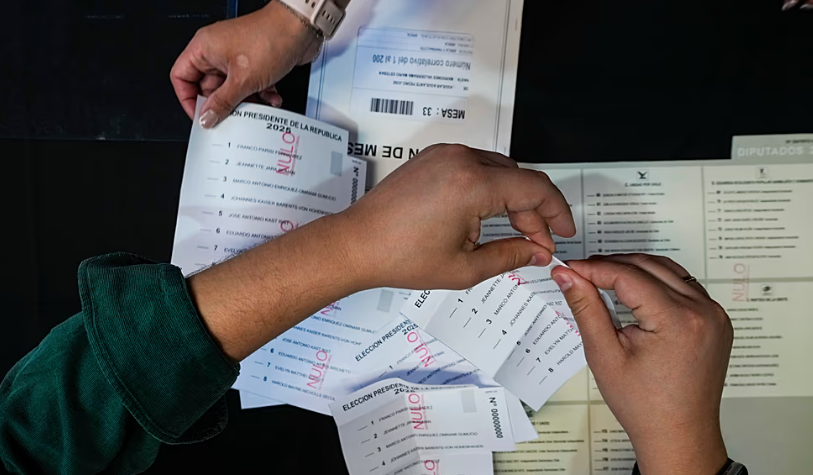
Chile is holding its presidential election on Sunday, with candidates campaigning on tough stances on crime and immigration. The vote comes four years after progressive Gabriel Boric was elected, at a time when the electorate is deeply divided and a new compulsory voting law adds an element of uncertainty.
Over 14 million Chileans are eligible to vote in the elections, which will also renew the entire Chamber of Deputies and nearly half of the Senate. Security and immigration concerns have dominated the campaign, shifting public attention toward conservative candidates. Evelyn Matthei has called for drug traffickers to be “in jail or in the cemetery,” while Franco Parisi described drug trafficking as “narco-terrorism” and advocated for “bullet or jail.”
The three main contenders offer contrasting visions for Chile’s future. José Antonio Kast, 59, a Republican Party member and the brother of a former minister who served under General Augusto Pinochet, is running for president for the third time. He has focused his campaign on combating crime and illegal immigration. Jeannette Jara, 51, a former minister in Boric’s government and member of the Communist Party, has pledged to expand pensions, lower electricity costs, and construct tens of thousands of new homes. Johannes Kaiser, 49, a former YouTube commentator and legislator, has questioned vaccination programs, opposed abortion, and promised to withdraw Chile from climate agreements and the Inter-American Court of Human Rights.
The introduction of compulsory voting in 2023 could significantly affect turnout, particularly among younger voters. Generation Z, born after 1996, accounts for roughly a third of the electorate, and polls suggest that 30% of these voters have yet to decide. Social media has played a major role, with candidates using platforms like TikTok to mobilize supporters. Jara and Matthei have accused Kast of orchestrating social media campaigns against them, allegations he denies.
Polls indicate a close race. Latest surveys show Jara leading with 30% support, followed by Kast at 22% and Kaiser at 15%. Prediction markets, however, see Kast as the frontrunner with a 70% chance of winning. Analysts suggest that none of the candidates is likely to secure an absolute majority on Sunday, making a run-off election probable on 14 December, likely between Jara and Kast.
A conservative or far-right advance could also reshape the legislative landscape. Polls suggest that both coalitions might achieve a majority in Congress, raising the possibility of a government with limited parliamentary opposition—a scenario not seen in Chile in the past 15 years.
Polling stations opened at 8:00 local time (UTC-4) and will close at 18:00. With crime, immigration, and economic issues at the forefront, this election is being closely watched as a test of Chile’s political direction in a highly polarized environment.
