


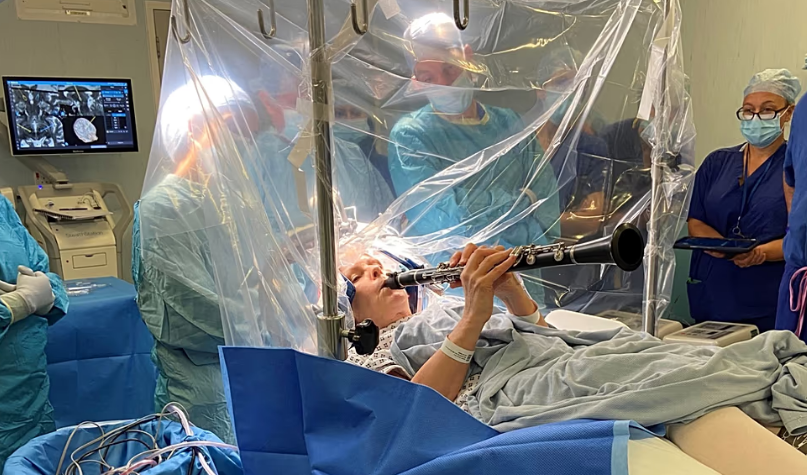
Doctors at King’s College Hospital in London have reported “instant” results following a groundbreaking brain-stimulation procedure that dramatically improved the symptoms of a 65-year-old woman with Parkinson’s disease — all while she played the clarinet on the operating table.
Denise Bacon, a retired speech and language therapist, was diagnosed with Parkinson’s disease in 2014. The progressive neurological disorder affects movement, causing tremors, stiffness, and slowness that worsen over time. For Bacon, these symptoms increasingly made it difficult to walk, swim, dance, and play her beloved clarinet — until she underwent deep brain stimulation (DBS), a complex surgical procedure designed to relieve symptoms in patients whose conditions do not respond well to medication.
The four-hour surgery was led by Professor Keyoumars Ashkan, a consultant neurosurgeon and professor of neurosurgery at King’s College London. During the procedure, Bacon remained awake under local anaesthetic while electrodes were implanted into targeted areas of her brain that control movement. These electrodes were connected to a pulse generator — similar to a pacemaker — that delivers electrical impulses to help regulate abnormal brain activity.
“The results were instant once stimulation was delivered to the brain,” said Professor Ashkan. “It was remarkable to see the improvement immediately on the operating table.”
Bacon herself described the experience as life-changing. “I remember my right hand being able to move with much more ease once the stimulation was applied, and this in turn improved my ability to play the clarinet,” she said, recalling the moment she realized the treatment was working.
The implanted pulse generator, powered by a battery located in Bacon’s chest, continuously delivers adjustable electrical currents to her brain. According to King’s College Hospital, the device could last up to 20 years before requiring replacement.
While DBS does not cure Parkinson’s or halt its progression, it can significantly reduce symptoms and improve quality of life. For Bacon, the early results have been encouraging. “I’m already experiencing improvements in my ability to walk,” she said. “I’m keen to get back in the swimming pool and on the dance floor to see if my abilities have improved there.”
Doctors at King’s College hailed the operation as another example of how advances in neurosurgery can transform lives. For Bacon, the return of fluid movement — and music — is nothing short of a personal triumph.
