


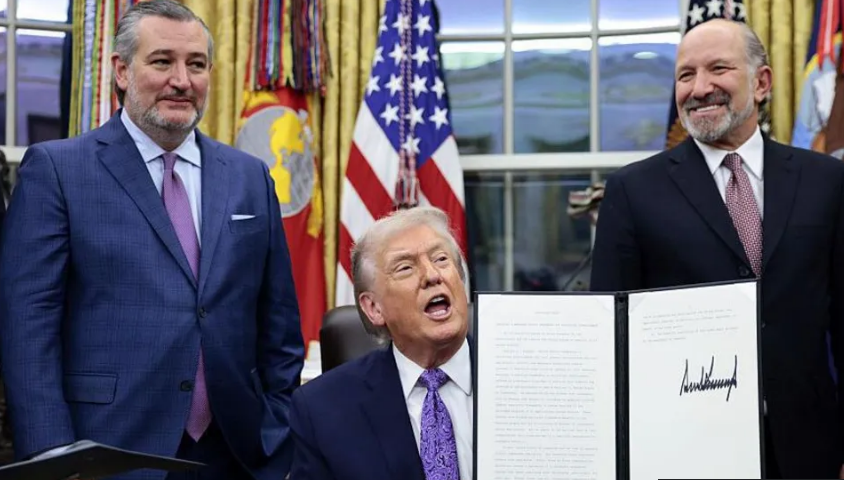
US President Donald Trump has signed an executive order that seeks to prevent individual states from imposing their own rules on artificial intelligence (AI), a move the White House says is intended to create a single national standard. Speaking in the Oval Office on Thursday, Trump said the measure aims to establish “one central source of approval” for AI regulation.
The order will give federal authorities tools to challenge what the administration considers the most “onerous” state-level rules, according to White House AI adviser David Sacks. Sacks noted that regulations aimed at protecting children would remain unopposed.
Tech companies have welcomed the move, arguing that a uniform federal framework would prevent a patchwork of state laws from slowing innovation. Executives at AI firms, including OpenAI, Google, Meta, and Anthropic, have previously warned that differing state regulations could hinder the US in its competition with China to dominate the AI sector.
“The executive order could be a major win for US technology firms,” Sacks said, highlighting the billions of dollars being invested into AI research and development.
However, the order has sparked strong criticism from state leaders and advocacy groups. California Governor Gavin Newsom, whose state hosts many major technology companies, described the move as a self-serving attempt to “enrich himself and his associates” and accused Trump of undermining protections for Americans. Earlier this year, Newsom signed a law requiring large AI developers to submit plans addressing risks from their models. Other states, including Colorado and New York, have also passed legislation regulating AI development.
Advocates for state-level regulation say such laws are essential in the absence of comprehensive federal rules. Julie Scelfo from Mothers Against Media Addiction said the executive order “undermines states’ basic rights to establish sufficient guardrails to protect their residents.”
Legal experts note that conflicting state regulations can create challenges for AI companies. Michael Goodyear, an associate professor at New York Law School, said, “It would be better to have one federal law than a bunch of conflicting state laws. However, that assumes that we will have a good federal law in place.”
Tech lobby group NetChoice praised the executive order, with policy director Patrick Hedger calling it a step toward “nationwide standards and a clear rulebook for innovators.”
The order comes amid growing debate over the regulation of AI, as companies race to develop increasingly advanced systems. While federal oversight could simplify compliance for businesses, critics warn that it may reduce local safeguards designed to protect privacy, safety, and consumer rights.
Trump’s executive action positions the federal government as the primary authority on AI policy, setting the stage for potential legal and political battles with states that have already enacted their own rules.
