


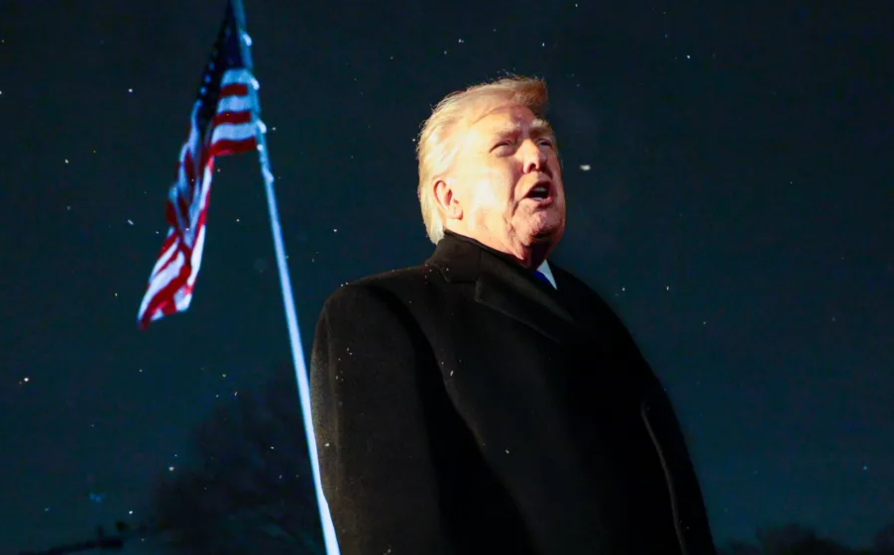
US President Donald Trump on Friday signed an executive order threatening to impose additional tariffs on countries that continue to trade with Iran, raising concerns over escalating tensions in the Middle East.
The order does not specify a precise tariff rate but cites 25 percent as an example. It applies to goods imported into the United States from any nation that “directly or indirectly purchases, imports, or otherwise acquires any goods or services from Iran.”
Trump did not comment directly on the order but reiterated his administration’s stance that Iran must not develop nuclear weapons during remarks from Air Force One on Friday night. “If they don’t make a deal, the consequences are very steep,” he said, referring to ongoing negotiations with Iranian officials in Oman.
The executive order follows a post on Trump’s social media platform, Truth Social, in January, in which he threatened a 25 percent tariff on countries doing business with Iran. The White House described Friday’s order as reaffirming the “ongoing national emergency with respect to Iran” and noted that the president could adjust the measure if circumstances change.
The order cites Iran’s pursuit of nuclear capabilities, support for terrorism, ballistic missile development, and regional destabilisation as threats to American security and interests. Separately, the US State Department announced sanctions against 15 entities for trading in Iranian-origin crude oil, petroleum products, or petrochemicals.
Iran, already subject to extensive US and Western sanctions, has not issued an immediate response. Tehran maintains that its nuclear programme is entirely peaceful and denies pursuing nuclear weapons. Under the 2015 nuclear deal, Iran was prohibited from enriching uranium above 3.67 percent and barred from activity at its Fordo facility for 15 years. Trump withdrew from the agreement in 2018, reinstating sanctions that crippled Iran’s economy and led Tehran to breach restrictions on uranium enrichment.
Despite sanctions, Iran continues to trade with over 100 countries. China remains its largest export partner, purchasing more than $14 billion in goods in the year to October 2025, followed by Iraq with $10.5 billion. Exports to Turkey jumped from $4.7 billion in 2024 to $7.3 billion last year, while the United Arab Emirates is also a major customer.
Talks between US and Iranian officials began in Oman on Friday, marking the first direct discussions since last June, when the US targeted three Iranian nuclear sites. The Iranian delegation, led by Foreign Minister Abbas Araghchi, met with US negotiators, including special envoy Steve Witkoff and Trump’s son-in-law Jared Kushner. Oman’s Foreign Minister Badr Albusaidi, who mediated the discussions, described them as “useful to clarify both Iranian and American thinking and identify areas for possible progress.” Araghchi called the talks “a good start” and said a positive atmosphere prevailed.
Trump has warned that Iran’s Supreme Leader Ayatollah Ali Khamenei “should be very worried” if the country does not reach a nuclear deal. The US has bolstered its military presence in the region, describing it as a “massive armada,” following a crackdown on anti-government protests in Iran, which human rights groups say has resulted in thousands of deaths.
The executive order and sanctions signal a hardline approach by the Trump administration, even as diplomatic efforts continue to prevent a wider confrontation.
