


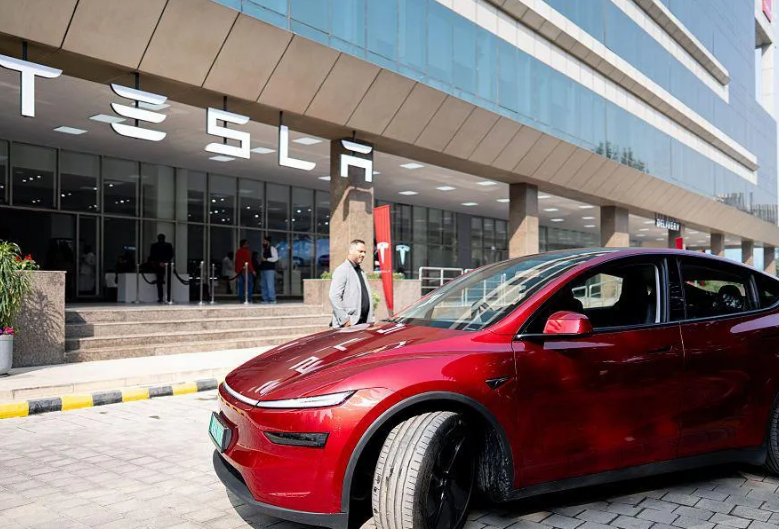
Tesla has launched its largest sales and service hub in India, aiming to boost its presence in the country despite slow sales since its debut in July. The new facility in Gurugram combines a showroom, charging stations, and after-sales services under one roof.
Since entering the Indian market, Tesla has sold just over 100 cars, according to dealership data. Bookings for the Model Y reached slightly over 600 vehicles by mid-September, but only a fraction converted into actual sales. Competitors such as BMW, BYD, and Mercedes-Benz have seen stronger demand in the premium EV segment, supported by festive buying and government tax incentives.
Tesla is now focusing on strengthening India’s EV ecosystem as part of a three-pronged strategy to boost adoption, expand charging infrastructure, and improve the customer experience. Speaking at the Gurugram launch, India head Sharad Agarwal highlighted the potential cost savings for buyers, estimating that fuel and maintenance could save up to two million rupees ($22,400) over four years, roughly a third of the Model Y’s price. He added that most maintenance is handled remotely through software updates, while home charging costs a tenth of petrol prices.
“Most of the [maintenance] service is done remotely through software updates, which reduces cost of ownership. And cost of home charging is one tenth of petrol prices,” Agarwal said.
Despite these advantages, analysts note the company faces significant challenges. Hormazd Sorabjee, editor of Autocar India, described Tesla’s current sales as “low by any standard” but suggested the company is taking a strategic approach. “They have just put their foot in the door in India. And they have good potential to increase sales here in the time to come,” he said.
Electric vehicles currently account for less than 3% of passenger car sales in India, and charging infrastructure is still limited, with only about 25,000 stations nationwide. Tesla’s vehicles can be charged at home, adding roughly 44 miles of range per hour, and the company is expanding its network of superchargers, which provide around 170 miles in 15 minutes.
Tesla’s struggles in India mirror a broader slowdown in global markets. Despite record revenue of $28 billion in the three months to September, profits fell 37% due to tariffs and research and development costs. While Tesla has prioritized an import-led strategy in India, it has shown little interest in local manufacturing, even as the government offers incentives for global EV producers.
The Gurugram centre represents Tesla’s most significant investment in India to date and signals its intent to establish a long-term presence, though achieving substantial sales growth will require overcoming high prices, limited infrastructure, and slow consumer adoption.
