


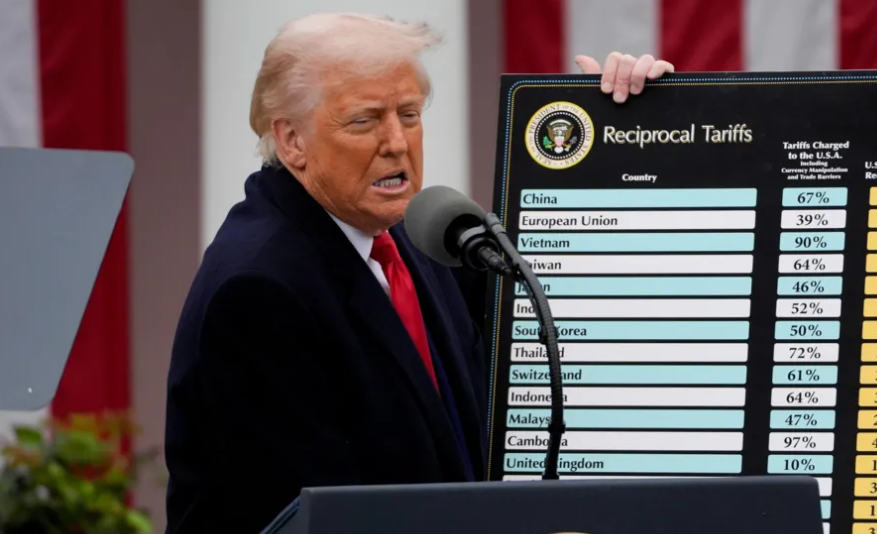
One year after US President Donald Trump launched his trade war, tariff rates in the United States have reached their highest levels in decades. Average effective tariffs now stand at around 10 percent, up from roughly 2.5 percent at the start of 2025. The policy changes have significantly altered global trade patterns, especially between the US and China.
The trade war began last April, when Trump unveiled a minimum 10 percent tariff on a wide range of foreign goods, including many from China. The announcement, made on what he called Liberation Day, triggered retaliatory tariffs from China, pushing some duties into triple-digit levels. The disruption temporarily stalled trade between the world’s two largest economies. By the end of 2025, tariffs on Chinese goods were 20 percent higher than at the start of the year.
The effects on trade volumes were immediate. The value of US imports from China fell by roughly 30 percent last year, while American exports to China dropped by more than 25 percent. Chinese goods now account for less than 10 percent of total US imports, a level last seen in 2000 and a sharp decline from over 20 percent in 2016, the year Trump was first elected.
Analysts say the changes reflect a long-term decoupling of the US and Chinese economies. Davin Chor, professor and chair of globalisation at Tuck School of Business, said the shift was dramatic and decisive, noting that many companies had already been planning to diversify supply chains before the tariffs were imposed. Even if aggressive tariffs are eventually reduced, Chor said, the break between the two countries is likely to persist.
Trade flows have also shifted toward other nations. US imports from Vietnam and Mexico have risen, partly as Chinese firms have invested there to maintain access to American markets. Companies around the world are looking beyond the US for buyers, adjusting their strategies to new political and trade realities.
Trump’s tariff measures were not limited to the April announcement. Additional levies were imposed on steel, lumber and cars, while rules allowing shipments under $800 to enter duty-free were eliminated. Despite the higher tariffs, US imports still grew by more than 4 percent last year, showing that American demand for foreign goods remains strong, though growth has slowed compared with 2024.
Countries such as the United Kingdom, which faced a relatively modest 10 percent tariff on its goods, saw their share of exports to the US decline as other nations like Germany, France, and Poland expanded their trade with America. The reshuffling of trade relationships highlights the far-reaching impact of Trump’s tariff regime on global commerce.
