


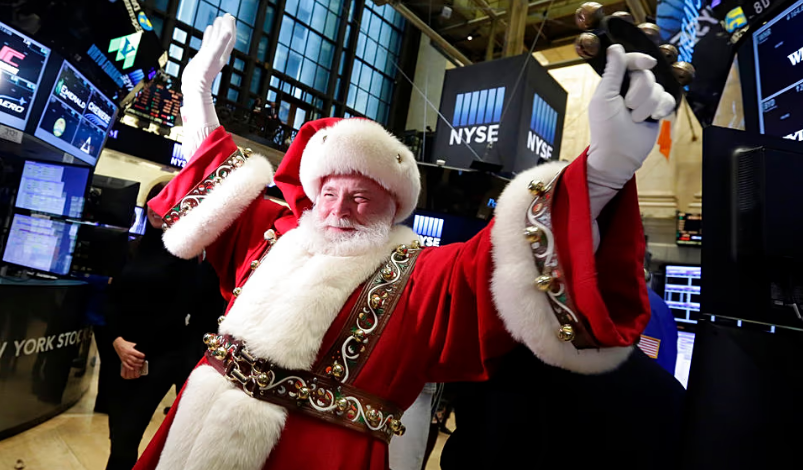
World stock markets delivered a mixed picture on Wednesday, with investors balancing hopes of a year-end Santa Claus rally against signs of slowing demand and inflation concerns. The S&P 500 in the United States closed at a fresh record high after a report showed the economy grew at an annual rate of 4.3% in the third quarter, exceeding expectations.
A Santa Claus rally refers to the tendency for share prices to rise in the final days of December and the early sessions of the new year. This trend is often driven by lighter trading, portfolio adjustments, and seasonal optimism among investors. While the phenomenon occurs regularly, it is not guaranteed and can be disrupted during periods of economic uncertainty or market stress.
US futures for the S&P 500 and the Dow Jones Industrial Average were down slightly by less than 0.1% ahead of early market closures for Christmas Eve. In Europe, Britain’s FTSE 100 dipped 0.2% to 9,870.89, while Paris’ CAC 40 added 0.2% to 8,121.32. Germany’s markets remained closed. Asian exchanges also saw uneven results: Tokyo’s Nikkei 225 fell 0.1% to 50,344.10, South Korea’s Kospi dropped 0.2% to 4,108.62, and Hong Kong’s Hang Seng gained 0.2% to 25,818.93. China’s Shanghai Composite rose 0.5% to 3,940.95, while Australia’s S&P/ASX 200 slipped 0.4% to 8,762.70. Taiwan’s Taiex rose 0.2% and India’s Sensex fell 0.1%.
Precious metals continued their upward trajectory, with gold reaching $4,525.20 per ounce, adding to a roughly 70% gain for the year, while silver climbed 1.6%. Rising geopolitical tensions have supported these safe-haven assets, even as equity markets show caution.
Despite record highs in US equities, uneven performances across Europe and Asia reflect investor concerns over inflation, interest rates, and the durability of global growth. In the US, major tech gains pushed the S&P 500 up 0.5% on Tuesday, while the Dow added 0.2% and the Nasdaq rose 0.6%. At the same time, consumer confidence declined in December, and the Federal Reserve’s preferred inflation gauge, the personal consumption expenditures index, rose to 2.8% in the third quarter from 2.1% in the previous quarter.
Currency markets saw the dollar fall against the Japanese yen, trading at 155.83 yen, down from 156.17, while the euro inched up to $1.1797. Oil prices rose slightly amid concerns over potential supply disruptions in Venezuela and Russia, with US crude at $58.50 per barrel and Brent crude at $61.95 per barrel.
With many exchanges closing early for the holidays, thinner trading volumes have amplified modest market movements. Investors are closely monitoring US jobless claims, inflation trends, and central bank signals to gauge the outlook for early 2026 trading.
