


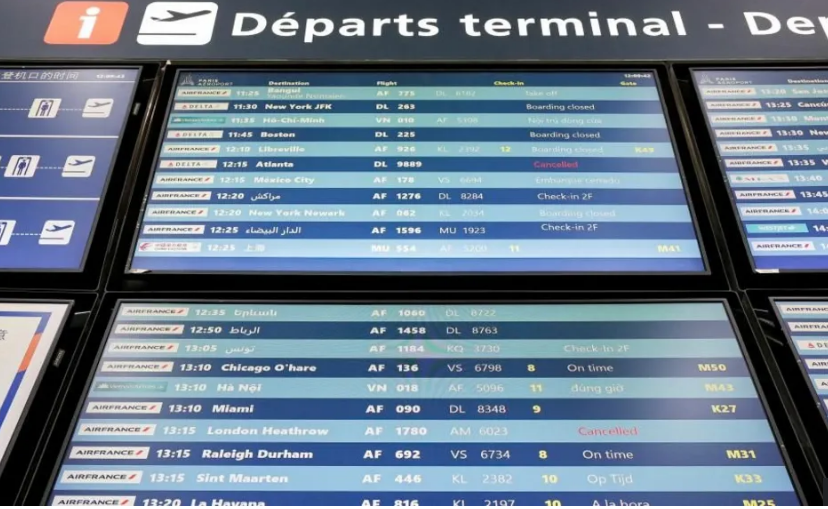
Tens of thousands of passengers have seen their travel plans thrown into disarray after a strike by French air traffic controllers led to widespread flight cancellations on Thursday and Friday, impacting air travel across France and much of Europe.
The two-day strike, organised by the UNSA-ICNA union, stems from long-standing grievances over staffing shortages, management practices, and the planned implementation of a controversial clock-in system for controllers. Talks with France’s civil aviation authority (DGAC) earlier this week failed to resolve the issues.
As a result, the DGAC ordered airlines to scale back operations, with around 25% of flights cancelled at major Paris airports—Charles de Gaulle, Orly, and Beauvais—and up to 50% at Nice airport. The disruption is expected to worsen on Friday, with as many as 40% of flights at Paris airports cancelled.
Low-cost carrier Ryanair reported that it had to cancel more than 170 flights, affecting the holiday plans of over 30,000 passengers. The airline’s CEO, Michael O’Leary, sharply criticised the strike, accusing air traffic controllers of “holding European families to ransom.”
“It makes no sense and is abundantly unfair on EU passengers going on holidays,” O’Leary said, calling on European Commission President Ursula von der Leyen to enforce minimum service guarantees during strikes and to shield overflights from domestic industrial actions.
The strike’s impact has extended beyond French borders, affecting flights crossing French airspace en route to destinations such as the UK, Ireland, Spain, and Greece. Airlines for Europe (A4E), the continent’s largest aviation group, described the situation as “intolerable,” warning of significant disruption at the peak of the summer travel season.
French Transport Minister Philippe Tabarot also condemned the timing and nature of the strike, criticising the unions for taking action at such a critical period for holidaymakers.
Budget airline easyJet, which was also hit by cancellations, voiced its “deep disappointment” and urged all parties to return to negotiations swiftly to prevent further disruption.
Meanwhile, Ryanair noted that it had also been affected by regional instability, citing over 800 flight cancellations last month due to the Middle East conflict. Nonetheless, the airline managed to operate more than 109,000 flights in June, suggesting that less than 1% of its operations were affected.
With no breakthrough in talks as of Friday morning, travellers are being advised to check with airlines for the latest updates and prepare for continued delays heading into the weekend.
