


Attempts to replicate the power of the Sun on Earth have long been described as one of science’s most difficult challenges, yet companies across Europe are pushing ahead with nuclear fusion projects that aim to deliver near-limitless clean energy.
Francesco Sciortino, co-founder and CEO of Munich-based Proxima Fusion, says scepticism has followed the project from the start. “I remember a few people said that the place where Proxima is today was impossible,” he said.
Fusion energy works by forcing hydrogen nuclei to merge at extremely high temperatures, releasing vast amounts of energy. On the Sun, gravity keeps the reaction going, but on Earth scientists must rely on powerful magnetic fields and extreme heat to control a plasma state hotter than the Sun’s core.
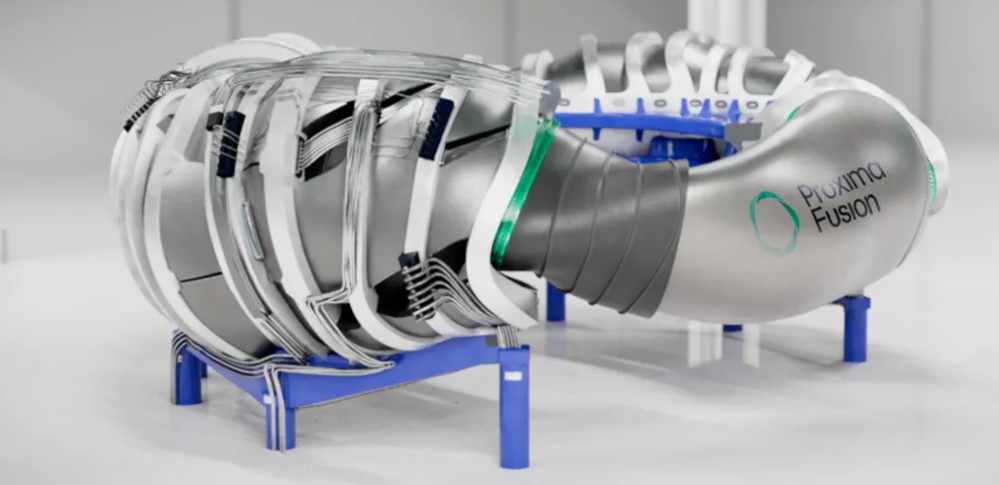
Most fusion projects use a tokamak, a doughnut-shaped chamber that uses magnetic fields to contain plasma. Proxima Fusion is instead developing a stellarator, a far more complex design with twisted magnetic coils intended to improve plasma stability.
Sciortino compared the two approaches bluntly. “A tokamak is a beast,” he said, while describing the stellarator as “a little cat” that is complex to build but easier to control once operating.
The company’s first device, Alpha, is based on decades of research from Germany’s Max Planck Institute for Plasma Physics and its W7-X stellarator. The goal is for Alpha to produce more energy than it consumes, paving the way for a future commercial plant named Stellaris.
However, the technical and financial hurdles remain significant. Proxima recently secured €400 million from the state of Bavaria and is seeking additional funding exceeding $1 billion from Germany’s federal government. A decision is expected next year.
Across Europe, around 53 fusion ventures are now competing to achieve commercial viability, according to the Fusion Industry Association. In the United Kingdom, the STEP programme is pursuing a tokamak-based reactor on the site of a former coal plant in Yorkshire.
Ryan Ramsey, a senior figure at STEP, said tokamaks benefit from decades of experimental progress and simpler magnetic designs, making them easier to manufacture and scale. “That has real implications for manufacturability, maintainability, and cost,” he said.
Despite this, Proxima believes stellarators could ultimately offer more stable and efficient operation. Sciortino admits the engineering challenge is intense, particularly the production of highly precise magnetic coils, but remains focused on scaling up production quickly. A prototype coil is already under construction, with testing planned for next year.
If successful, around 40 additional coils will be required for Alpha, alongside a new magnet manufacturing facility expected to ramp up production by 2028 or 2029.
Sciortino argues Europe’s strong industrial base could provide an advantage in this emerging sector, pointing to its large skilled manufacturing workforce. “We missed the digital wave,” he said, “but we still have people trained in manufacturing.”
While no fusion reactor has yet achieved sustained net energy gain, researchers across Europe agree the field is entering a critical phase where engineering progress, rather than theoretical physics, will determine the outcome.
