


European natural gas prices have fallen sharply in recent days, even as much of the continent faces an early and cold winter, highlighting the growing influence of US liquefied natural gas (LNG) exports on the market. On Tuesday, the Dutch Title Transfer Facility (TTF) benchmark dropped below €28 per megawatt-hour, a level not seen since April 2024.
Since the start of 2025, European gas prices have declined by more than 45%, and they remain over 90% below the record highs seen during the 2022 energy crisis. At the same time, gas storage levels remain below seasonal norms. European inventories were 75% full as of 30 November, roughly 10% below the five-year average. In Germany, storage levels are even weaker at 67%, more than 20% below typical seasonal levels.
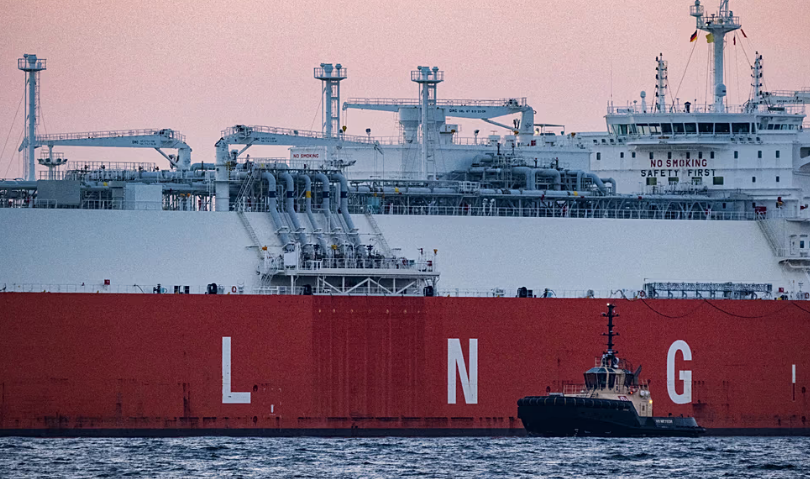
The main factor driving the decline is the surge in US LNG exports to Europe. Kpler data shows that American cargoes accounted for approximately 56% of Europe’s LNG imports this year. With Asian demand relatively subdued and US export capacity strong, Europe has become the primary destination for American LNG, providing a steady supply that offsets lower Russian flows and eases market pressure.
The growing influx of LNG has narrowed the historical price gap between European and US gas, known as the TTF-Henry Hub spread. At the start of 2025, the difference stood at about $12 per million British thermal units (MMBtu). By late November, the spread had fallen to just $4.8, the lowest level since May 2021. TTF gas now trades at just under $10/MMBtu, roughly twice the price of Henry Hub gas, which averaged $5.045 this week. By contrast, during the 2022 energy crisis, TTF prices spiked to around €350/MWh ($100/MMBtu), while Henry Hub remained near $10, producing a record transatlantic spread of nearly $90/MMBtu.
Analysts say the narrowing gap reflects a broader realignment in global energy flows. US LNG has emerged as a key buffer for Europe, easing concerns over shortages and stabilizing the market.
Looking ahead, Goldman Sachs predicts the trend of abundant LNG supply will continue through the decade. Samantha Dart, head of commodities research at the bank, forecasts that European storage levels will rise and TTF prices will gradually fall to €29/MWh in 2026 and €20/MWh in 2027. By 2028–2029, storage congestion in Northwest Europe could push TTF as low as €12/MWh, narrowing the US LNG export arbitrage and potentially lowering Henry Hub prices to $2.70/MMBtu. Beyond 2030, rising demand from Asia driven by decarbonization policies and infrastructure growth could tighten global LNG markets, lifting Henry Hub above $4 and TTF above €30/MWh by 2033.
The current price drop demonstrates how transatlantic energy flows, particularly US LNG exports, are reshaping Europe’s gas market, providing relief despite cold weather and below-average inventories.
