


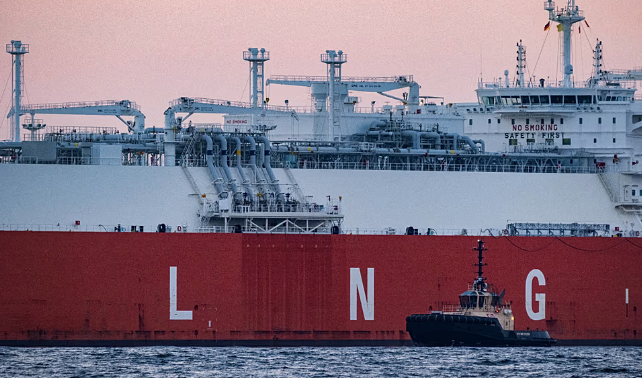
Europe is on track to rely heavily on the United States for its liquefied natural gas imports in 2026, with American supplies expected to account for nearly two-thirds of total LNG shipments to the continent, according to a new analysis by the Institute for Energy Economics and Financial Analysis (IEEFA).
The report, released on Wednesday, highlights how Europe’s energy landscape has been reshaped in the years following Russia’s invasion of Ukraine and subsequent geopolitical tensions, including disruptions linked to the war involving Iran. These developments have accelerated a shift away from Russian fossil fuels and increased dependence on alternative suppliers, particularly the United States.
IEEFA estimates that US LNG already made up about 57% of Europe’s imports in 2025, a significant rise compared with levels before the conflict. The organisation said the share is likely to grow further as additional long-term supply agreements come into effect and Europe continues to reduce its reliance on Russian gas.
The European Union is pursuing a policy under its REPowerEU framework to eliminate Russian fossil fuel imports by 2027. Since 2022, member states have rapidly increased purchases of LNG, with the United States emerging as the dominant supplier.
While the shift has helped stabilise energy supplies during periods of disruption, the report warned that it has also created a new dependency risk. Concentrating imports from a single external supplier, even a reliable ally, could leave Europe exposed to future price shocks, political pressures, or supply constraints.
The IEEFA noted that US LNG typically costs more than pipeline gas due to liquefaction, transportation, and regasification expenses. It estimates that European countries spent about €117 billion on US LNG between early 2022 and mid-2025.
Despite rising imports, overall gas consumption in Europe has been declining. High energy prices, weaker industrial demand, energy conservation efforts, and the expansion of renewable energy sources have all contributed to reduced usage. In 2024, LNG imports fell as demand reached its lowest level in more than a decade, before rebounding in 2025 due to colder weather and efforts to refill storage facilities.
Some European policymakers have warned against replacing dependence on Russian energy with reliance on another dominant supplier. European Commission Executive Vice President Teresa Ribera has urged greater investment in renewable energy and electrification to reduce structural dependence on imported fossil fuels.
The European Union Agency for the Cooperation of Energy Regulators has also raised concerns about growing supply concentration linked to US LNG.
At the same time, countries such as Germany have expanded LNG infrastructure, including floating terminals, making them among the largest importers of US gas in Europe. However, analysts caution that continued expansion of import capacity may exceed long-term demand as Europe accelerates its energy transition toward cleaner sources.
