


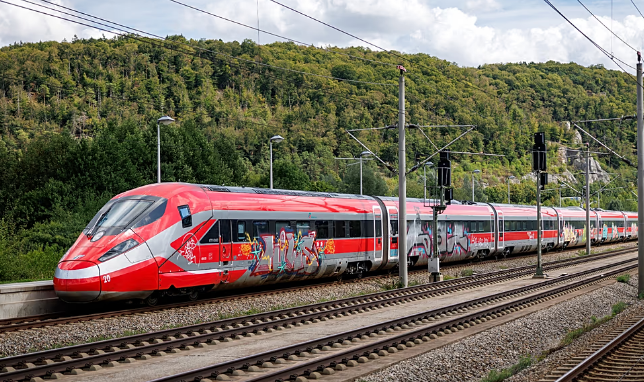
Italy’s Frecciarossa high-speed trains have begun trial runs in Germany and Austria as preparations advance for new rail connections linking Rome and Milan with Munich from summer 2027.
The tests, carried out by Trenitalia under the Ferrovie dello Stato Group, form part of the international certification process required before the trains can operate on the German and Austrian rail networks.
FS said services between Milan and Munich and between Rome and Munich are planned for summer 2027, subject to the successful completion of the approval process for the new trains.
The expansion will strengthen Italy’s high-speed rail links with central Europe. Frecciarossa services already operate internationally to France and Spain, while FS has set a longer-term goal of reaching the United Kingdom through the Channel Tunnel by 2029.
The German and Austrian expansion is being developed in partnership with Deutsche Bahn and Austrian Federal Railways, known as ÖBB.
The planned opening of the Brenner Base Tunnel is expected to reduce journey times between Italy and Germany by around one hour. From December 2028, the wider international service is expected to provide 10 connections between Italy and Germany, covering routes between Milan, Rome and Munich, with later extensions planned to Naples and Berlin.
The initial commercial service will feature four connections across the Milan to Munich and Rome to Munich routes.
The Milan to Munich journey is expected to take around six and a half hours. Major intermediate stops will include Brescia, Verona, Rovereto, Trento, Bolzano and Innsbruck.
The Rome to Munich service will take approximately eight and a half hours, with stops planned in Florence, Bologna, Verona, Rovereto, Trento, Bolzano and Innsbruck.
FS chief executive and general manager Gianpiero Strisciuglio said the start of testing in Germany and Austria represented an important step toward expanding rail travel across Europe.
He said cooperation with Deutsche Bahn and ÖBB was helping create a high-speed “European Metro” capable of connecting regions, people and economies more closely.
Italian Transport and Infrastructure Minister Matteo Salvini also welcomed the development, describing it as another step in FS’s international expansion and its efforts to improve rail services and infrastructure.
The partnership between Trenitalia and Deutsche Bahn includes the exchange of technical expertise to help Frecciarossa trains operate with different electricity supply and signalling systems. The cooperation is intended to simplify technical requirements and control costs.
Training programmes for German and Austrian train drivers have also been launched alongside the development of the trains.
The Frecciarossa is designed to meet European interoperability standards and is already capable of operating across several European rail networks, including those of France, Germany, Spain, Austria, Switzerland, the Netherlands and Belgium.
The new Munich services are expected to create additional travel options for passengers heading beyond Germany, including destinations such as Frankfurt and Krakow.
