


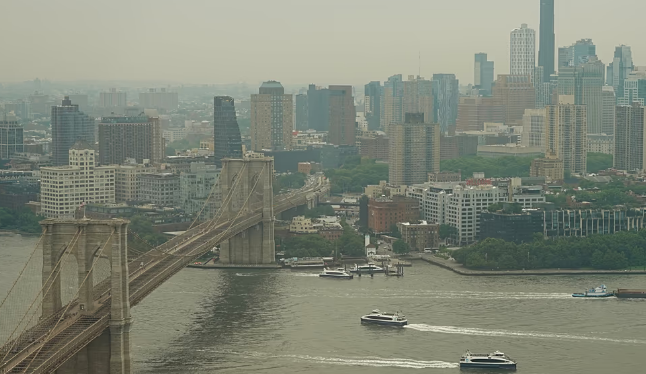
A thick layer of smoke drifting from Canada’s wildfires has reduced air quality across New York and New Jersey just days before the 2026 FIFA World Cup final, raising health concerns for players and tens of thousands of fans expected to attend Sunday’s showdown between Spain and Argentina at MetLife Stadium.
New York awoke on Thursday under orange-tinted skies as smoke from hundreds of wildfires burning across Canada’s Ontario province spread across the northeastern United States. Many of the fires remain out of control, with weather patterns carrying smoke from the Great Lakes region toward New Jersey and New York.
Meteorologists said the situation has been made worse by a heat dome that is trapping polluted air close to the ground instead of allowing it to disperse.
Authorities issued air quality alerts on Thursday after pollution levels reached categories considered unhealthy. Although conditions improved slightly later in the day, health officials continued to advise residents to limit outdoor activity, particularly those most vulnerable to poor air quality.
The New York City Department of Health urged people to avoid prolonged outdoor exposure and strenuous exercise while advising extra caution for children, older adults and individuals with asthma or other respiratory illnesses. KN95 face masks have also been distributed through libraries, police stations and fire stations across the city.
Attention has now turned to Sunday’s World Cup final, which is expected to attract around 82,500 spectators to MetLife Stadium in East Rutherford, New Jersey. Unlike many modern venues, the stadium does not have a roof, meaning players, officials and supporters will be exposed to outdoor air conditions throughout the match.
Health experts have warned that prolonged exposure to wildfire smoke can pose significant health risks. Fine particles carried in the smoke can penetrate deep into the lungs, increasing the risk of breathing problems, particularly for people with existing respiratory or heart conditions.
The poor air quality has already affected preparations for the final. Spain’s national team, which is training in New Jersey, modified Thursday’s training session due to the conditions. Media access was also shortened, with journalists only allowed to observe the opening minutes of practice.
Argentina’s preparations have been less affected, as the defending champions have been training in the Atlanta area, where smoke levels have remained considerably lower.
Despite the deteriorating air quality, FIFA and local authorities have not indicated any plans to postpone or relocate the World Cup final.
Weather forecasts offer some optimism, with rain expected over the weekend that could help clear the smoke before kickoff on Sunday evening.
As anticipation builds for one of football’s biggest matches, air quality has become an unexpected talking point alongside tactical preparations and team selections, with organizers continuing to monitor environmental conditions ahead of the final.
