


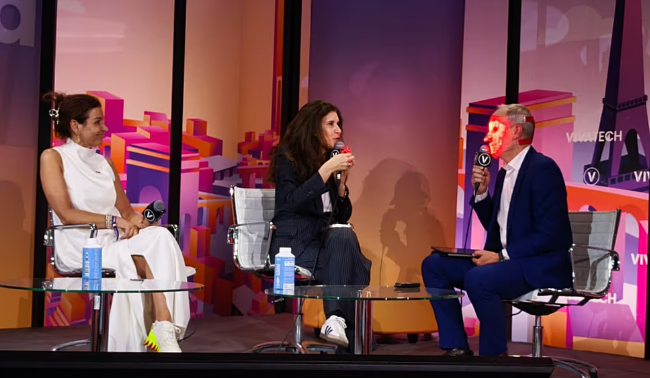
At VivaTech 2026, senior executives from major global firms including L’Oréal and PwC delivered a unified message: maintaining personal vitality and building organisational resilience are no longer optional goals, but essential drivers of competitiveness in a rapidly changing world.
During a Euronews-hosted discussion at the Paris technology event, the conversation opened with a light remark from Delphine Viguier, Chief Innovation and Prospective Officer at L’Oréal, who joked that she had “more wrinkles than my business plan.” The comment set the tone for a broader comparison between personal ageing and corporate evolution.
Viguier said that whether dealing with visible signs of ageing or strategic stagnation, the response must be similar: adapt habits and embrace change. In her view, this includes skincare routines and supplements on a personal level, while companies must invest in innovation, open themselves to external ideas and encourage creativity to stay competitive.
Pauline Adam-Kalfon, Chief Innovation and Impact Officer at PwC France and Maghreb, focused on organisational discipline. She argued that successful reinvention begins with subtraction rather than expansion. Businesses, she said, should eliminate activities that no longer add distinct value instead of continuously layering new initiatives on top of existing structures.
Both executives emphasised the importance of data in separating meaningful trends from passing fads. At L’Oréal, Viguier noted that large-scale datasets, increasingly analysed with artificial intelligence, help identify patterns in consumer behaviour and reduce repeated strategic mistakes. She also highlighted the importance of balancing short-term trends with long-term product strategy in a fast-moving beauty market.
Adam-Kalfon shared PwC research showing that only a small share of companies capture the majority of value generated by AI adoption. According to her, roughly 20% of firms account for nearly three-quarters of AI-driven gains, with top performers achieving productivity or revenue improvements several times higher than the rest.
She said bridging this gap requires treating AI as a growth tool rather than only an efficiency measure, and scaling successful experiments quickly across organisations.
Another key theme was diversity. Both speakers stressed that exposure to different perspectives—within teams and beyond traditional professional networks—strengthens decision-making and long-term adaptability. Viguier likened it to biology, saying mixed origins often lead to greater resilience and vitality.
Adam-Kalfon added that when companies struggle, the root cause is usually not surface-level issues but deeper structural problems: declining relevance to customers, shrinking margins, and slower decision-making processes that limit responsiveness.
The session also featured practical demonstrations, with L’Oréal presenting its LED skincare device designed for cellular-level skin rejuvenation, while PwC showcased an AI-based tool aimed at assessing organisational health and readiness for technological change.
Despite the innovation on display, both speakers cautioned against expecting easy fixes. There were no shortcuts to longevity, they said—only consistent attention to data, behaviour, and adaptation.
