


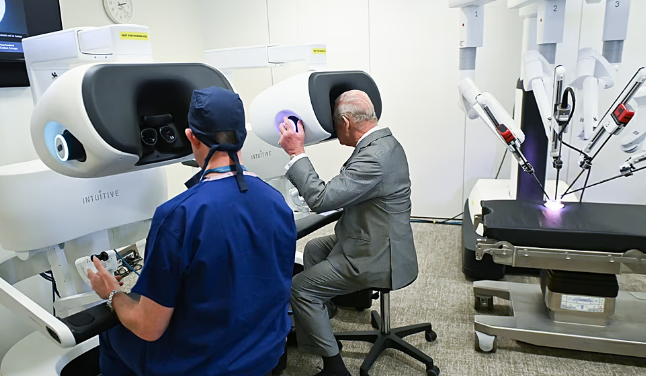
The National Health Service is stepping up its investment in robotic-assisted surgery, with the UK government aiming for robots to be involved in nine out of 10 keyhole operations in England by 2035. Surgeons at a leading London hospital say the technology is already improving precision, reducing recovery times and helping shape the future of surgical care.
At St Bartholomew’s Hospital in central London, consultant thoracic surgeon Sasha Stamenković recently used the latest da Vinci 5 robotic-assisted surgical system to remove a lung tumour during a complex procedure. Operating from a console equipped with an immersive 3D display, he guided robotic arms fitted with surgical instruments while communicating with his operating team throughout the operation.
Stamenković said the technology allowed surgeons to carry out highly intricate procedures while preserving more healthy lung tissue. During the operation, he successfully navigated around tiny blood vessels and airways, reducing the amount of tissue that needed to be removed.
The system, developed by US medical technology company Intuitive, is being introduced at more NHS hospitals as part of a wider plan to increase robotic-assisted keyhole surgery. St Bartholomew’s is also training surgeons from across England to use the technology before it becomes available in their own operating theatres.
Keyhole surgery involves making small incisions rather than one large cut, usually resulting in less pain, smaller scars and faster recovery for patients. Robotic systems are now being used across a range of specialties, including thoracic, colorectal, abdominal, urology and gynaecology procedures.
Ali Ansaripour, a senior cardiothoracic trainee completing a year-long robotic surgery fellowship, said adapting to operating from a console rather than standing directly beside the patient required adjustment. He added that the high-definition three-dimensional view provided by the system gives surgeons greater clarity and supports more precise decision-making.
According to Stamenković, the robotic instruments move with greater flexibility than conventional laparoscopic tools, allowing surgeons to perform delicate movements more naturally. He said the increased precision can reduce complications such as air leaks, a common issue following lung surgery that often extends hospital stays.
The benefits have also been noticed by patients. Ian Macleod, a 76-year-old retired detective, became the first NHS patient to undergo lung cancer surgery using the da Vinci 5 system. He said he only learned he would be the first recipient shortly before the operation but felt comfortable proceeding.
Macleod described his recovery as remarkably quick. He was walking within 30 minutes of returning to the ward and left hospital with only one stitch. Having previously undergone traditional keyhole surgery for another cancer, he said this recovery was significantly faster. Less than a week after the operation, he was well enough to drive his wife to a local garden centre.
Robotic surgery has been identified by the government as one of five priority areas in its 10-year health plan for England. However, the Royal College of Surgeons of England has warned that access to robotic procedures varies across the country and criticised the absence of a consistent national funding model. Some hospitals continue to depend on charitable donations to purchase the equipment.
Stamenković said expanding training will be essential if the NHS is to meet its long-term target, adding that younger surgeons are adapting quickly to the new technology and will play a key role in its wider adoption.
