


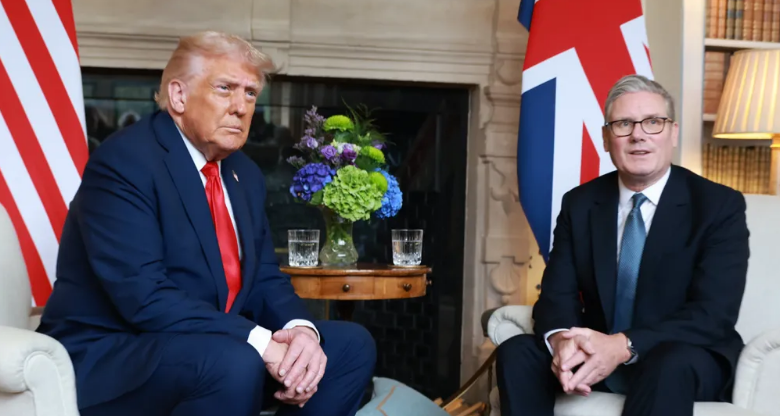
Just yesterday, the prime minister made the case for “calm discussion” with the United States. He wakes up this morning to President Trump personifying a political Catherine wheel: spinning, unpredictable, colourful and firing off reactions at every angle. Every angle, including in the direction of the UK, and in particular Sir Keir Starmer. This moment poses a massive strategic question for the prime minister: how to respond.
Sir Keir’s government has built much of its foreign policy on being seen as a dependable, trustworthy ally of President Trump. For months, this relationship was regarded in Downing Street as an unlikely success. The president had spoken warmly of the prime minister in public, and the UK believed it enjoyed a closer rapport with Washington than many European allies. Last year’s deal on tariffs was touted as proof of the advantages of cultivating this connection.
Now, however, that trust is being tested. Trump has publicly criticized the UK’s agreement to hand the Chagos Islands to Mauritius, a deal announced last year to secure the long-term future of the military base at Diego Garcia, a key US-UK installation in the Indian Ocean. Senior officials emphasize that the deal was legally and strategically justified. Legal challenges over Britain’s claim to the islands had threatened the base’s viability, and the agreement had been publicly welcomed by the US and Australia, both members of the Five Eyes intelligence alliance.
The president’s reversal, expressed in a characteristic blitz of capital letters on social media, contrasts sharply with his initial support. When the deal was first announced and discussed in the Oval Office last May, Trump had signaled approval. Now his splenetic reaction highlights the unpredictable nature of the UK-US dynamic under his leadership.
The government is also defending another controversial move: approval for a new Chinese embassy in London. The site, long sought by Beijing, has faced criticism for potential security risks. Officials in Washington are reported to have concerns that the UK may appear too close to China, and this decision comes just weeks before the prime minister is expected to visit Beijing. Analysts suggest that the embassy approval could trigger further outrage from Trump, adding to the pressure on the prime minister.
For Sir Keir, these developments underscore the delicate balance of managing relations with a US president whose positions can shift dramatically. While Downing Street has stressed the legal and strategic rationale behind both the Chagos and embassy decisions, the volatility of US responses leaves the UK government navigating a high-stakes diplomatic landscape.
Observers note that the combination of US criticism and domestic scrutiny creates a complex challenge for the prime minister, who must maintain alliances while safeguarding national interests. How he manages this moment may define the early months of his government on the international stage.
