


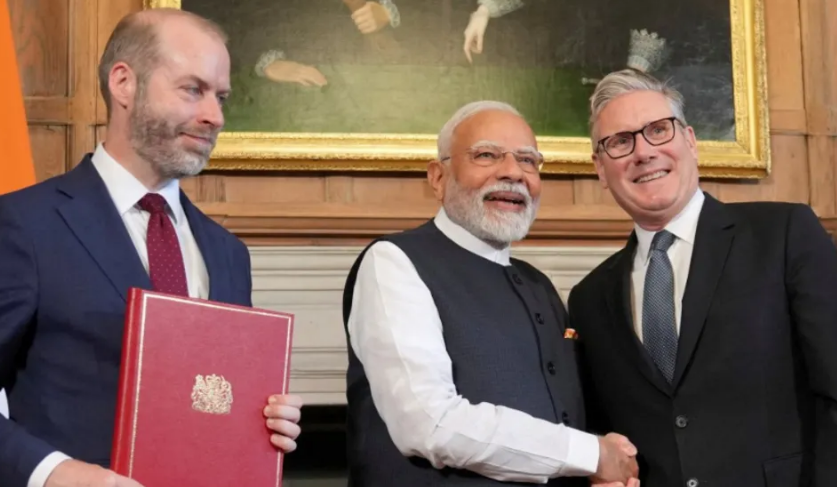
British Prime Minister Sir Keir Starmer and Indian Prime Minister Narendra Modi have signed a landmark free trade agreement, marking the UK’s most significant post-Brexit economic pact. The deal is expected to deliver a multi-billion-pound boost to exports on both sides and deepen ties between the two countries.
The long-anticipated agreement, three years in the making, was signed at Chequers, the British prime minister’s country residence. It lowers or eliminates tariffs on a wide range of goods, including UK cars, whisky, aerospace components, and food products, while making Indian textiles, jewellery, and electric vehicles more competitive in the UK market.
“This is the biggest and most economically significant trade deal Britain has struck since Brexit,” said Prime Minister Starmer. “We are sending a powerful message that Britain is open for business.”
The UK government estimates the agreement could boost the British economy by £4.8 billion annually and create over 2,200 jobs across the country. Indian companies will also benefit from greater access to UK markets, particularly in the automotive and technology sectors.
The deal includes a range of tariff reductions:
-
Tariffs on UK whisky exports to India will drop from 150% to 75%, with a gradual reduction to 40% by 2035.
-
Average tariffs on UK goods heading to India will fall from 15% to 3%.
-
Indian exports such as clothing, footwear, seafood, gems, and jewellery will see improved access to the UK market.
Prime Minister Modi hailed the deal as “a blueprint for our shared prosperity,” emphasising that both Indian and British industries would benefit from improved access and lower trade barriers.
Beyond trade, the agreement includes cooperation in key areas such as defence, education, technology, and climate. It also strengthens bilateral collaboration on security, fraud, and migration. A new criminal record sharing system will be introduced to support law enforcement and travel bans.
On migration, the agreement includes an extension of social security exemptions for seconded workers, meaning temporary staff will only pay contributions in their home country. The UK government stressed this is in line with existing arrangements with other nations and will not give Indian workers a tax advantage over British counterparts.
The deal, approved by India’s cabinet earlier this week, will now be subject to UK parliamentary approval and is expected to come into force in 2026.
While the agreement falls short of opening India’s financial and legal services sectors to the extent the UK had hoped, talks continue on a bilateral investment treaty to protect cross-border investments. Discussions also remain ongoing over the UK’s proposed carbon tax, which India argues could unfairly affect its exports.
Modi’s visit, his fourth to the UK since becoming prime minister in 2014, follows a year of expanding bilateral cooperation, including the UK-India Technology Security Initiative signed in 2024.
The deal has sparked political debate, with the opposition Conservatives claiming it was only possible due to Brexit. However, Labour maintains it reflects a modern economic vision for the UK, grounded in global cooperation.
