


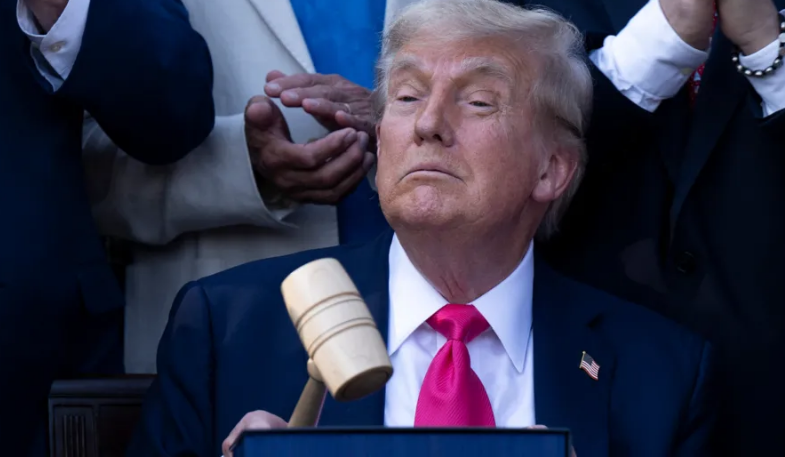
As U.S. President Donald Trump hailed the passage of his self-styled “Big Beautiful Budget Bill” this week, alarm bells rang across global financial markets over the growing burden of American debt and the long-term sustainability of Washington’s borrowing strategy.
The newly passed budget, which includes sweeping tax cuts and increased spending on defense and infrastructure, is projected to add at least $3 trillion to the United States’ national debt — which already stands at a staggering $37 trillion. Critics, including former Trump ally Elon Musk, have decried the move, with Musk calling the bill a “disgusting abomination.”
Analysts say the scale of U.S. borrowing is once again under intense scrutiny. The country routinely borrows to cover the gap between federal income and expenditure, but signs are emerging that investors may be growing wary of how much more the U.S. can take on.
The U.S. dollar has declined 10% against the British pound and 15% against the euro since January. At the same time, yields on long-term Treasury bonds have risen compared to short-term rates, a development known as a “steepening yield curve” — often viewed as a red flag over fiscal sustainability.
Billionaire hedge fund manager Ray Dalio, founder of Bridgewater Associates, believes the U.S. is approaching a fiscal crossroads. “If this is not dealt with now,” he warned, “the debts will build up to levels where they can’t be managed without great trauma.” Dalio estimates that loan and interest payments could reach $10 trillion annually in the near future.
Economists outline three potential responses to a worsening debt crisis: deep spending cuts or tax increases; large-scale money printing by the Federal Reserve; or, in a worst-case scenario, a U.S. default. While the first option is politically contentious, the second risks fueling inflation and widening inequality. The third — a U.S. default — would shake the foundation of the global financial system.
Despite the concerns, many experts agree that the dollar remains dominant — for now. Mohamed El-Erian, a prominent economist, said that although countries are gradually reducing their dollar holdings, there are few viable alternatives. “The dollar is like your cleanest dirty shirt — you have to keep wearing it,” he remarked.
The Bank of England has also acknowledged the global implications. Governor Andrew Bailey said the scale of U.S. debt is “very much on Secretary Bessent’s mind” and confirmed that it is a topic of high-level discussion among economic policymakers.
Though America’s $37 trillion debt appears daunting, the country also boasts a $25 trillion annual GDP and remains one of the world’s most dynamic economies. Still, as critics point out, the status of the U.S. dollar as the world’s reserve currency is not guaranteed — and without fiscal discipline, even the strongest economies can reach a tipping point.
