


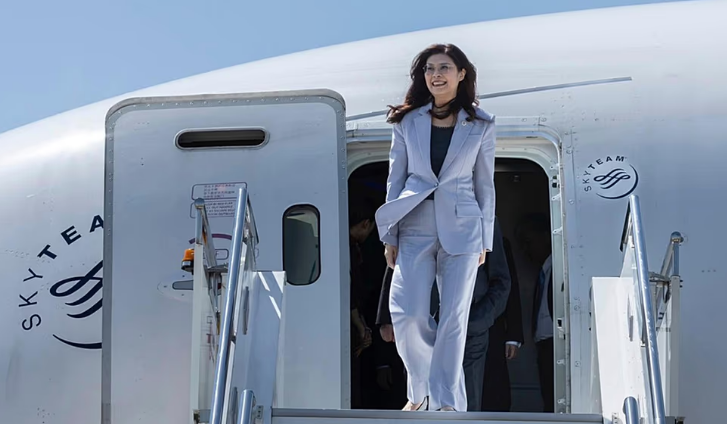
Taiwan’s opposition leader Cheng Li-wun arrived in China on Tuesday for a six-day visit described as a “journey for peace,” marking the first trip by a Taiwanese opposition figure to the mainland in a decade. The visit comes as Beijing continues its long-standing push for the self-ruled island to accept its sovereignty and ahead of a planned summit between US President Donald Trump and Chinese President Xi Jinping in May.
Cheng, chairperson of Taiwan’s Kuomintang (KMT) party, said before departing Taipei that her goal was to promote dialogue and reduce tensions. “The purpose of this visit to mainland China is precisely to show the world that it is not just Taiwan that unilaterally hopes for peace,” she said. She added that the trip aimed to demonstrate a willingness on both sides to resolve differences through engagement.
Her visit begins in Shanghai and is set to conclude in Beijing, though it remains unclear whether she will meet Xi during the trip. The timing is significant, with US-China relations under close scrutiny and Taiwan expected to feature prominently in discussions between the two leaders.
China considers Taiwan part of its territory and has not ruled out the use of force to bring the island under its control. In recent months, Beijing has increased military pressure, sending warplanes and naval vessels near Taiwan and conducting live-fire drills, including exercises held in December.
The United States has criticised these activities, with the State Department warning they raise tensions and calling on China to halt military pressure. Washington remains Taiwan’s strongest informal ally and continues to supply the island with defensive weapons. A major arms package announced by the Trump administration in December, valued at more than $11 billion, is expected to be a key topic at the upcoming summit.
China has repeatedly opposed such military ties, describing Taiwan as an internal matter. Foreign Ministry spokesperson Mao Ning said Beijing’s position on US support for Taiwan remains “consistent and clear.”
Cheng’s visit has also drawn mixed reactions at home. Dozens of supporters and critics gathered at Taipei’s airport, reflecting divisions within Taiwan over how to engage with Beijing. While her party advocates closer ties and dialogue, Taiwan’s current government maintains that the island is a sovereign entity. President Lai Ching-te’s administration has had no direct engagement with Beijing, which labels him a “separatist.”
Meanwhile, Taiwan’s opposition-controlled parliament has stalled a proposed $40 billion defence budget that would fund arms purchases from the United States and support domestic military development. The delay highlights ongoing political debate over how best to address security concerns.
Taiwan has been governed separately from China since 1949, following a civil war that led to the establishment of the Communist government in Beijing. Cheng’s visit underscores ongoing efforts by some political groups to reopen communication channels, even as tensions remain high across the Taiwan Strait.
