


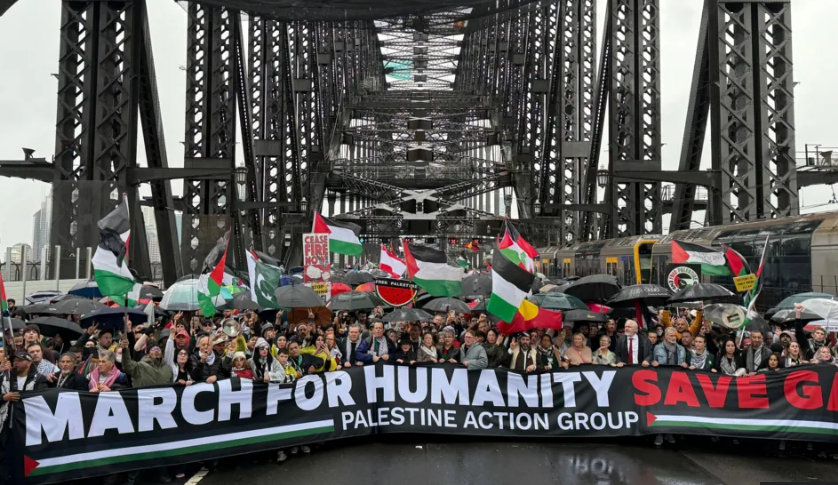
Tens of thousands of demonstrators marched across the Sydney Harbour Bridge on Sunday in a major pro-Palestinian rally, following a last-minute decision by the New South Wales Supreme Court to allow the event to proceed. The protest, dubbed the March for Humanity, went ahead despite heavy rain and a prior attempt by police to block the gathering on safety grounds.
The Supreme Court ruling, delivered just one day before the protest, was hailed by organisers as a “historic” moment. Justice Belinda Rigg ruled that while public safety concerns raised by police were valid, organisers had made a compelling case for the urgency of the demonstration in response to the humanitarian crisis in Gaza. She found no evidence that banning the protest would enhance safety and authorised the temporary closure of the bridge and surrounding roads.
Crowds filled the iconic Sydney Harbour Bridge carrying Palestinian flags and placards calling for an immediate ceasefire. Chants of “Shame shame Israel, shame shame USA” and “What do we want? Ceasefire. When do we want it? Now,” echoed across the bridge. Many participants brought children and babies to the peaceful march, reflecting its broad appeal across families and communities.
Among those seen at the protest were WikiLeaks founder Julian Assange, federal MP Ed Husic, and former NSW Premier Bob Carr.
Despite earlier warnings from the police and government, the protest remained peaceful. Officers from the riot squad were stationed throughout the route to maintain order. However, around two hours into the event, attendees received a text alert from NSW Police instructing them to stop moving north and return toward the city “in a controlled way,” citing public safety.
Transport authorities urged motorists to avoid the area, warning of widespread delays and disruptions across Sydney’s roads and public transport network.
The Palestine Action Group, which organised the march, had lodged its intent last Sunday. Police initially rejected the request, citing insufficient time for traffic planning and potential crowd safety risks. NSW Premier Chris Minns supported the police stance earlier in the week, warning the protest could cause chaos and stating the government could not endorse such a large-scale event on the bridge.
Nevertheless, the Supreme Court’s ruling ensured that attendees were legally protected under the Summary Offences Act, which shields participants in authorised assemblies from prosecution for offences such as obstructing traffic.
The protest adds to growing international pressure on Australia to formally recognise Palestinian statehood, following recent declarations by France, the UK, and Canada expressing support under specific conditions. Prime Minister Anthony Albanese, speaking to the ABC’s 7.30 programme, reiterated that Australia would make its own decision based on ensuring lasting security for both Israel and Palestine.
