


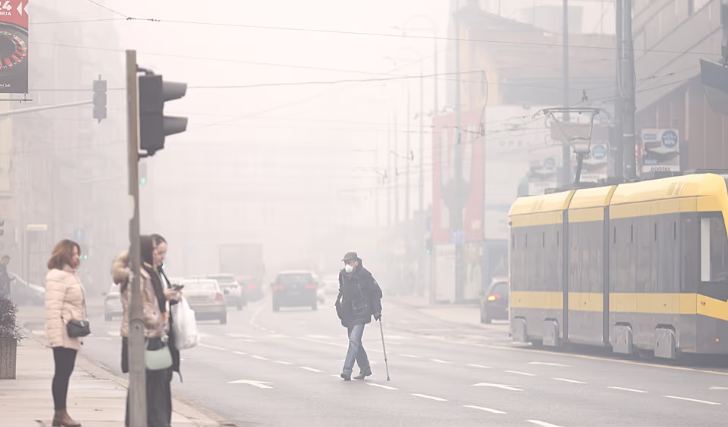
India is home to the world’s most polluted city, according to IQAir’s 2025 World Air Quality Report. The Swiss pollution monitoring company analysed data from 9,446 cities across 143 countries, regions, and territories, finding that only 14 percent of cities worldwide now meet safe air standards, down from 17 percent last year.
The report cites human-caused climate change as a major driver of worsening air quality, with wildfire smoke, dust storms, and extreme weather events intensifying pollution levels. Europe experienced its worst wildfire season on record in 2025, with blazes peaking in August and causing extensive damage to farms, woodlands, and homes. The resulting heatwaves, floods, and droughts contributed to at least €43 billion in short-term economic losses.
The World Health Organization sets safe limits for PM2.5, fine particulate matter less than 2.5 micrometres in diameter that can penetrate deep into the lungs and bloodstream. These particles have been linked to respiratory diseases, cardiovascular conditions, and long-term illnesses including cancer.
Only three European countries met the WHO annual PM2.5 guideline of 5 micrograms per cubic metre in 2025: Andorra, Estonia, and Iceland. Globally, just 13 countries and territories met the standard, including Australia, Barbados, Bermuda, French Polynesia, Grenada, New Caledonia, Panama, Puerto Rico, Réunion, and the US Virgin Islands. This means 91 percent of the countries analysed fell short of safe air levels.
South Asia continues to face the highest pollution levels. The five most polluted countries were Pakistan, Bangladesh, Tajikistan, Chad, and the Democratic Republic of the Congo. The world’s 25 most polluted cities were all in India, Pakistan, and China, with India claiming three of the four worst spots. Loni, in Uttar Pradesh, topped the list with an annual average PM2.5 concentration of 112.5 µg/m³—nearly 23 percent higher than in 2024 and more than 22 times the WHO guideline. Traffic, industrial emissions, road dust, and fly tipping were identified as the main pollution sources. By contrast, Nieuwoudtville in South Africa recorded the lowest levels, with just 1.0 µg/m³.
Across Europe, 23 countries recorded rising PM2.5 levels in 2025, while 18 saw decreases. Switzerland and Greece experienced increases of more than 30 percent due to wildfire smoke and Saharan dust. Malta achieved the largest reduction at nearly 24 percent, aided by renewable energy adoption and traffic emission controls.
Real-time monitoring shows some major European cities continue to face serious pollution. Paris, London, and several Eastern European capitals ranked among the most polluted at the time of reporting, with seasonal factors such as agricultural emissions, pollen, and stagnant weather compounding the problem.
IQAir warns that gaps in air quality data persist. Only a portion of the global population has access to real-time, hyper-local monitoring, and previous cuts to programs in the United States have left millions without information. Frank Hammes, CEO of IQAir, stressed that “expanding access to real-time data empowers communities to act” and that addressing emissions and climate change is crucial to improving global air quality.
