


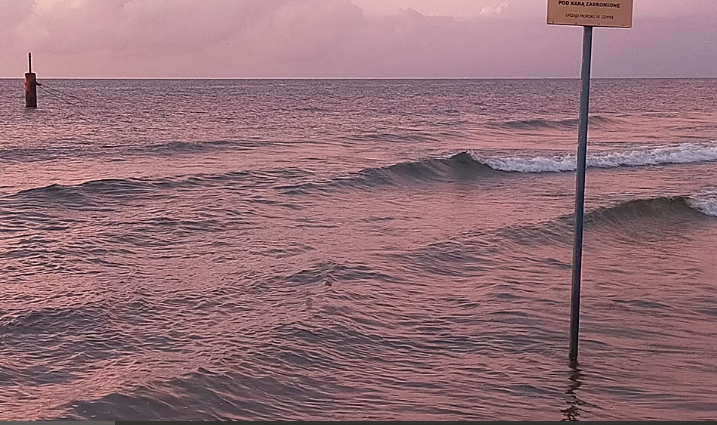
At the beginning of February, the water level in the Baltic Sea dropped sharply. Experts tell Euronews it is a result of climate change. While global ocean levels are generally rising, the Baltic Sea lost an estimated 275 billion tonnes of water, leaving levels 67 centimetres below the long-term average recorded in 1886. Scientists describe the phenomenon as unprecedented in the last 140 years.
According to Dr. Tomasz Kijewski of the Institute of Oceanology at the Polish Academy of Sciences, the drop is largely due to atmospheric factors, including strong easterly winds, a persistent high-pressure zone, and the absence of significant weather fronts. These winds pushed water through the Danish Straits toward the North Sea, reducing levels throughout the Baltic basin.
“This is 275 cubic kilometres of water,” Kijewski said. “The exceptional scale of this event is linked to larger atmospheric processes, including disturbances to the polar vortex and shifts in the jet stream caused by warming in the Arctic.” He likened the effect to an “open fridge,” where cold air escapes and causes unexpected changes elsewhere.
Experts emphasize that the drop is not isolated from the broader impacts of climate change. The Baltic Sea, like other shallow bodies of water, is particularly sensitive to rising temperatures, increased freshwater inflows, and nutrient pollution from rivers. These factors favor algal blooms, which consume oxygen and threaten marine life.
Anna Sowa, also from the Institute of Oceanology, noted that species from lower latitudes are moving northward in a process called borealisation. Her research in the Arctic between 2004 and 2020 showed declines in endemic species such as Harmeria scutulata, suggesting that warming is reorganizing marine ecosystems. She highlighted that Arctic regions are heating roughly four times faster than the global average, contributing to glacier melt, desalination of surface waters, and increasing acidification.
The drop in the Baltic Sea has sparked wider concern about ocean health. Kijewski warned that warming seas can devastate ecosystems, pointing to coral reefs, which could lose up to 90 percent of their cover with 1.5°C of warming. “A vibrant reef can turn into an underwater wasteland within weeks,” he said.
Despite these challenges, some environmental improvements have been recorded in the Baltic. Pollution has declined thanks to EU-led wastewater treatment initiatives, and seagrass meadows have returned to areas such as the Bay of Puck. However, the sea’s slow hydrological turnover means full recovery will take decades.
The cod population, which depends on colder, saltier bottom waters, is under pressure, while blue-green algae continue to thrive. Experts agree that human interference has already caused significant damage, and the most effective action now is restraint. “The only thing we can do,” Kijewski said, “is not interfere.”
