


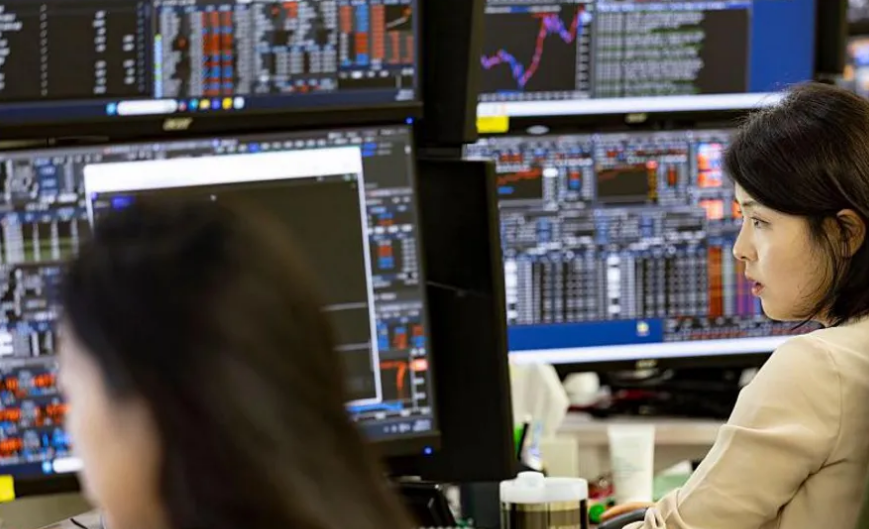
South Korea’s stock market was forced to suspend trading for 20 minutes on Monday after the Kospi index plunged nearly 9% within minutes of the opening bell, underscoring heightened volatility across global financial markets. The emergency “circuit breaker” mechanism, designed to prevent panic-driven trading, was triggered for the third time this year following a steep sell-off in technology shares.
When trading resumed, losses remained deep, with the Kospi still down around 7.9% by early afternoon. The sharp decline was led by major semiconductor firms, including Samsung Electronics and SK Hynix, as investors pulled back from high-valued tech positions.
Japan’s Nikkei 225 also slid sharply, falling about 4.5%, marking its steepest drop in three months. Technology stocks weighed heavily on the index, reflecting broader concerns across Asia’s equity markets.
The sell-off extended across the region, with Taiwan’s Taiex falling sharply after semiconductor giant TSMC dropped 3%, while Hong Kong’s Hang Seng and China’s Shanghai Composite also posted losses. The weakness followed a broader downturn on Wall Street, where the Nasdaq fell nearly 4% on Friday in its worst session in over a year.
Market analysts linked the declines to a combination of factors, including fears that artificial intelligence-related stocks may have become overvalued after a prolonged rally. Investors have begun reassessing earnings expectations, with growing pressure for tech firms to demonstrate tangible revenue growth from AI investments.
Charu Chanana, chief investment strategist at Saxo, described the environment as a “messy mix” of shocks driven by technology sector corrections and rising energy costs. She said investors were rapidly repositioning portfolios as uncertainty increased.
Adding to the pressure, oil prices surged after renewed violence between Iran and Israel raised fears of broader regional escalation. Brent crude rose more than 4% to $97.34 a barrel, while US crude climbed 4.3% to $94.40.
The latest exchange of strikes follows a fragile ceasefire agreement reached in April between the United States, Israel and Iran. Tehran warned that further attacks would continue throughout the week, while Israel responded with strikes on Iranian military targets despite calls from US President Donald Trump urging restraint.
Traders are increasingly pricing in the risk of prolonged instability in the Middle East, particularly regarding the Strait of Hormuz, a critical route for global oil shipments. Analysts warn that continued tensions could sustain energy price volatility and further fuel inflation concerns worldwide.
South Korean President Lee Jae-myung acknowledged expected market turbulence but maintained that domestic equities remained undervalued despite recent losses.
With geopolitical tensions rising and tech valuations under scrutiny, investors across Asia and beyond are facing a period of heightened uncertainty, where sentiment is being driven as much by politics as by corporate earnings.
