


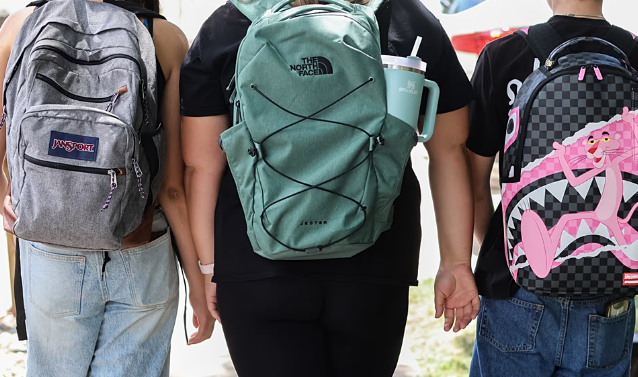
As families prepare for the new school year, health experts are urging parents to pay close attention to the weight of their children’s backpacks, warning that overloaded bags can place unnecessary strain on growing bodies.
Modern students often carry far more than textbooks. Laptops, tablets, chargers, notebooks, water bottles, lunch boxes, sports equipment and musical instruments can quickly add up, particularly for children who walk to school or take part in activities after classes.
The American Academy of Pediatrics says parents should watch for signs that a backpack is too heavy. Children who lean forward while carrying their bags or have difficulty walking may be struggling with excessive weight. Backpack straps should also fit comfortably rather than digging into the shoulders.
Sadika Kendi, a physician involved in the academy’s injury prevention work, said serious back injuries are uncommon but can occur, especially if a child falls while carrying a heavy bag.
She noted that a commonly cited recommendation is to keep a backpack between 10% and 15% of a child’s body weight. However, there is not enough evidence to establish one limit that is suitable for every child.
Children differ in size, strength and physical development, while their daily activities also vary. Kendi said parents should therefore consider their child’s individual needs and try to keep the backpack as light as possible.
Choosing the right bag can also make a difference. Health authorities recommend backpacks with two wide, padded and adjustable shoulder straps. The straps should be tightened so the bag remains close to the body, with the bottom positioned just above the child’s waist.
A waist belt can provide additional support by helping distribute some of the load.
Backpacks with wheels may be useful for some children, particularly those recovering from injuries. However, they can create problems in schools with stairs or crowded corridors and may become a tripping hazard.
Experts also recommend checking the contents of a backpack regularly. Parents can go through school supplies and remove items that are not needed each day.
Samantha Ness, a history teacher in Phoenix, Arizona, said families should focus on essential school supplies rather than expensive or decorative products.
Students in her classroom have access to textbooks but are expected to carry laptops and chargers. As digital learning has expanded, some pupils now bring very few paper materials.
Older students can also begin treating backpacks as personal storage, filling them with items such as cosmetics, hair products and other belongings that are not required for school.
A regular backpack check can help remove unnecessary items and reduce the strain on children’s shoulders and backs throughout the school day.
