


The death toll from relentless monsoon floods and landslides in Pakistan and Pakistan-administered Kashmir has risen to at least 307, with officials warning that more heavy rain is expected in the coming days.
Most of the casualties have been reported in the mountainous Khyber Pakhtunkhwa province in northwestern Pakistan, where swollen rivers and collapsing hillsides have swept away homes and infrastructure. Provincial disaster authorities said at least 74 houses had been damaged, while rescue operations suffered a further tragedy when a military helicopter crashed in bad weather during relief efforts, killing all five crew members on board.
In Pakistan-administered Kashmir, nine people have been confirmed dead, while another five fatalities were reported in Gilgit-Baltistan in the country’s far north. Authorities have declared several districts disaster zones as meteorologists predict intense rainfall will continue until at least August 21.
Survivors described the devastation in harrowing detail. In Buner district, one resident compared the floods to “doomsday.” “I heard a loud noise as if the mountain was sliding. I rushed outside and saw the entire area shaking, like it was the end of the world,” said Azizullah, adding that the ground trembled with the force of the water.
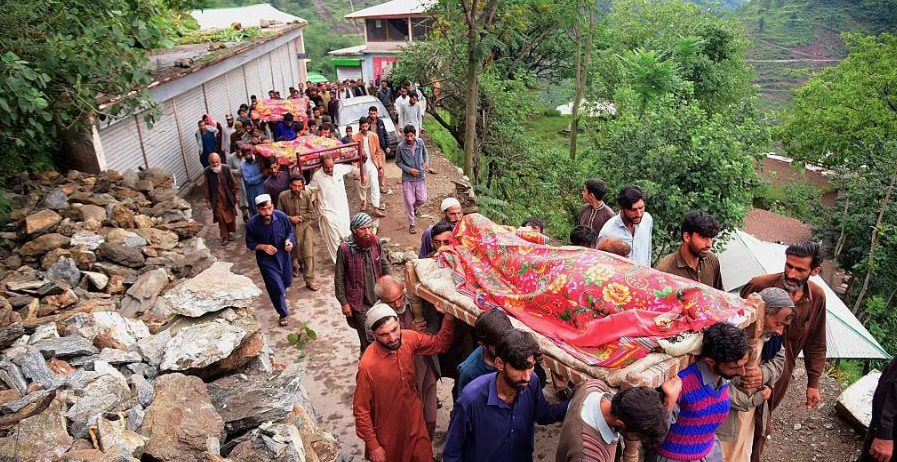
The provincial government of Khyber Pakhtunkhwa has declared a day of mourning, as images from the Bajaur region showed residents gathered around excavation machinery searching through mud-soaked hillsides. Nearby, funeral prayers were held for victims as grieving families stood by bodies wrapped in blankets.
In Indian-administered Kashmir, rescue teams continued to pull bodies from mud and debris on Friday after a powerful flood swept through a Himalayan village. At least 60 people were killed there, with dozens more still missing.
The annual South Asian monsoon, which lasts from June to September, brings around three-quarters of the region’s yearly rainfall. While vital for agriculture, the downpours also trigger frequent floods and landslides. This year’s season has already claimed more than 300 lives in Pakistan alone. Punjab province, home to nearly half of Pakistan’s 255 million people, recorded 73 percent more rainfall in July compared to last year, with fatalities surpassing the total for the entire previous monsoon season.
Experts warn that climate change is intensifying such disasters, with heavier rains and more destructive flooding occurring across South Asia. “The frequency and severity of these weather events is directly linked to rising global temperatures,” scientists have cautioned, urging stronger mitigation and adaptation measures.
With forecasters warning of more rain in the coming days, authorities are bracing for additional casualties and damage as Pakistan struggles to cope with another devastating monsoon season.
